
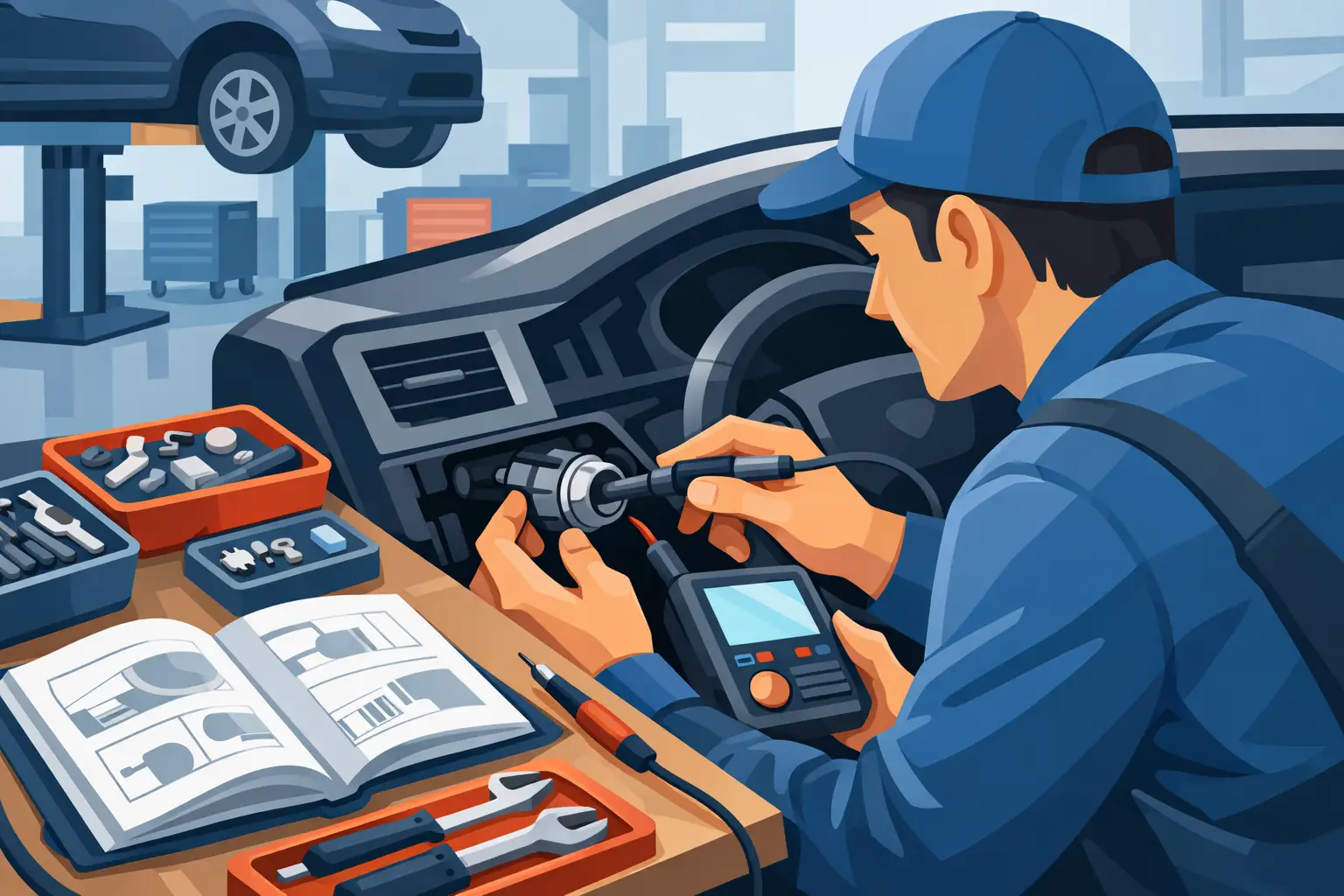
You usually get one warning before an ignition barrel gives up – the key starts sticking, you have to jiggle it, or the steering lock feels like it is fighting you. Leave it too long, and a small annoyance turns into a car that will not start at all. That is why car ignition barrel repair is often the fastest way to stop a bad day from getting worse.
For most drivers, the problem shows up without much context. The key goes in but will not turn. It turns halfway and jams. It only works if you hold your mouth right and wiggle the wheel. In some cases, the key will not come out. In others, it snaps in the ignition because the barrel was already worn and binding.
What a car ignition barrel actually does
The ignition barrel is the part you insert the key into. Inside it are small wafers or pins that match the cuts on your key. When the correct key lines everything up, the barrel turns and allows the ignition switch to do its job.
That sounds simple, but the barrel sits at the center of a lot of daily wear. Every start, every heavy keyring, every worn key blade, and every rushed twist puts stress on it. Over time, the internal parts wear down. Dirt and metal debris can build up too. Once that happens, the key may stop aligning the wafers properly, and the barrel becomes stiff, unreliable, or fully seized.
Common signs you need car ignition barrel repair
A failing ignition barrel rarely goes from perfect to dead in one step. Most of the time, there are warning signs. The key may feel rough going in, or it may need a second attempt before it turns. You might notice that one key works better than your spare, which often points to key wear as well as barrel wear.
Another common sign is when the steering lock stays engaged longer than it should. Drivers often assume the steering wheel is the problem, but sometimes the barrel is sticking and not releasing cleanly. If the key gets trapped in the ignition, or only comes out when you move it back and forth, that is another red flag.
There is also the issue of inconsistent starting. If the key turns but the car does not always crank, the fault could be deeper than the barrel itself. Some vehicles have a separate ignition switch, immobilizer ring, or electronic module involved. That is why proper diagnosis matters. Not every no-start issue is solved by replacing parts.
Why ignition barrels fail
Wear is the biggest reason. Car keys are metal, ignition wafers are metal, and constant friction takes its toll. If your main key is badly worn, it can gradually wear the barrel into the same pattern until both are unreliable.
Force is another major cause. If a key has been bent, copied poorly, or used while the steering lock is under pressure, the barrel can suffer internal damage. Heavy keychains do not help either. They put extra strain on the key while driving, especially on rough roads.
Then there is contamination. Dust, pocket lint, moisture, and tiny metal filings can get inside over time. Spraying the wrong lubricant into the ignition can make things worse by attracting grime. What starts as a sticky feel can turn into a complete seizure.
Attempted theft or tampering is a different category altogether. If the ignition has been forced with a screwdriver or the housing has visible damage, a simple repair may not be enough. In those cases, the barrel, ignition switch, and sometimes related security components may all need attention.
Repair or replacement – which makes sense?
This depends on the condition of the barrel and the vehicle. In many cases, car ignition barrel repair is the sensible first option. If the problem is caused by wear, sticking wafers, contamination, or a damaged internal component that can be rebuilt, repair can restore smooth operation without replacing the full assembly.
Repair also makes sense when you want to keep the car on one key. Replacing the wrong part can create a mismatch where the door locks work with one key and the ignition needs another. A skilled auto locksmith can often repair or rekey the barrel so it continues to match your existing key, which is far more convenient.
Replacement becomes more likely if the barrel is badly seized, physically broken, tampered with, or beyond safe rebuilding. Some modern vehicles also use assemblies that are not practical to repair on the spot. That said, replacement should still be approached properly. The goal is not just to make the key turn once. It is to restore reliable daily use and keep the vehicle secure.
Why key problems are often part of the same job
A worn ignition barrel and a worn key usually travel together. If the key blade has rounded edges, a repaired barrel may still feel inconsistent unless the key is cut correctly as well. This is where many quick fixes fall short. Someone frees the barrel, the car starts, and the deeper cause gets ignored.
A proper job means checking both sides of the problem. If the key is too worn to operate the repaired barrel reliably, it should be decoded and cut back to the correct pattern where possible. If there is a transponder chip or immobilizer issue, that has to be considered too. Starting problems are not always purely mechanical.
Why a mobile locksmith is often the fastest option
If your car will not start because of the ignition, towing it to a dealership is rarely the easiest route. It costs more, takes longer, and often turns a one-day problem into a drawn-out booking process. A mobile auto locksmith can diagnose the fault where the vehicle is parked and, in many cases, complete the repair on-site.
That matters when you are stranded at home, at work, in a parking lot, or on a job. For drivers in the West Midlands and nearby areas, fast-response mobile service can mean the difference between losing a full day and getting back on the road quickly. That is exactly why companies like Car Key Maker focus on on-site ignition and key work rather than sending customers through the hassle of recovery and dealership delays.
What the repair process usually looks like
First, the fault needs to be identified properly. If the key will not turn, the locksmith checks whether the issue is steering lock tension, key wear, barrel damage, or a related ignition component. If the key is stuck, extraction has to be done carefully to avoid making the barrel or housing worse.
Once the cause is clear, the barrel may be removed and stripped for inspection. Worn wafers, broken springs, internal debris, or damage from force can often be found at this stage. Depending on the design, the locksmith may rebuild the barrel, rekey it, lubricate it correctly, and test it with a properly cut key.
If replacement is the better route, the new or refurbished barrel is fitted and matched as closely as the vehicle setup allows. On some cars, additional programming or immobilizer work may be needed. That is why experience matters. Ignition issues can cross over between locks, keys, and electronics.
How much does car ignition barrel repair cost?
There is no honest flat answer because vehicle make, model, damage level, and key condition all affect the job. A straightforward repair on a common vehicle is usually far less expensive than dealership replacement, especially once towing is factored in. A more involved job with a seized barrel, broken key extraction, or immobilizer complications will cost more.
What matters most is getting a realistic diagnosis instead of guessing. Paying for a proper on-site repair is usually cheaper than replacing parts that were never the real problem. Fair pricing also means explaining whether repair is viable before pushing replacement.
What you should not do
Do not force the key. If it is sticking, twisting harder can snap the blade or damage the internal wafers. Do not keep spraying random products into the ignition either. Some lubricants leave residue that traps dirt and makes the barrel worse over time.
It is also worth avoiding worn copy keys if the original is already struggling. A badly duplicated key can accelerate barrel wear fast. If the ignition is becoming unreliable, getting it checked early is usually the cheapest move.
When to call for help
If the key will not turn, will not come out, feels rough every time, or has broken in the ignition, it is time to get it looked at. The same applies if the steering lock and ignition are fighting each other, or if starting has become inconsistent without another obvious reason.
The best time to deal with an ignition barrel is before it leaves you stranded. Once it fully fails, your options narrow and the stress goes up. A quick diagnosis and the right repair can often save the barrel, save the key setup, and save a lot of wasted time.
If your ignition is starting to act up, treat it like a warning, not a quirk. Cars rarely fix themselves, and ignition barrels are one of those parts that usually get more expensive the longer they are ignored.