
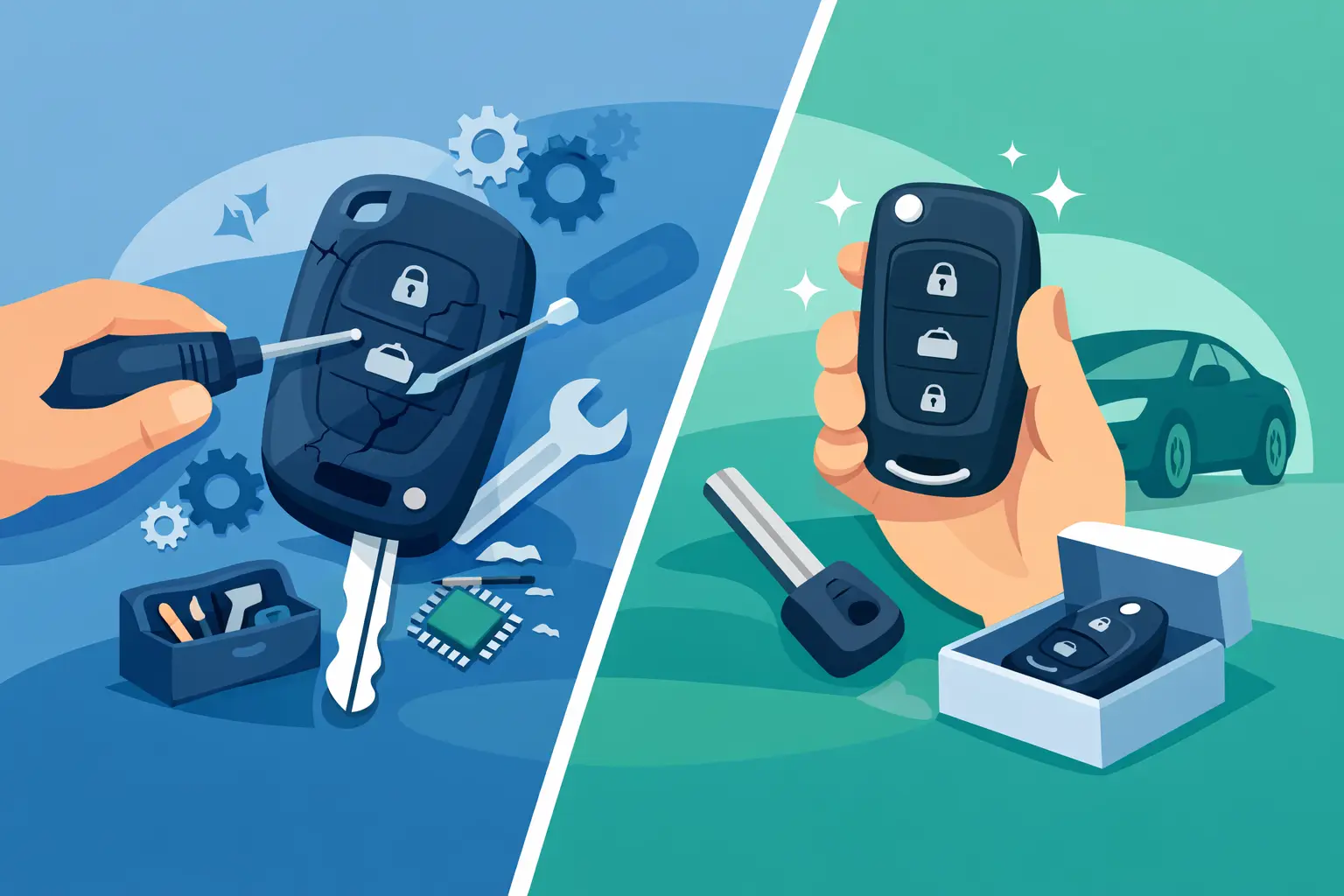
Your key worked yesterday. This morning it will not unlock the car, the buttons are hit or miss, or the blade is bent enough that you are forcing it in the ignition. That is usually when the question becomes urgent: car key repair vs replacement – which one actually makes sense, and which one just wastes time?
The short answer is that it depends on what failed. Some problems are worth repairing because the fix is quick, practical, and cheaper. Others are signs that the key is no longer reliable, and replacing it is the smarter move before you end up stranded in a parking lot, outside your home, or late for work.
Car key repair vs replacement: what changes the answer?
The biggest factor is not the age of the key. It is the type of fault.
If the issue is limited to a worn case, a damaged button pad, a weak battery contact, or a snapped shell on a remote key, repair is often a good option. In those cases, the electronics may still be fine. A skilled auto locksmith can move the internal board and transponder into a new housing, restore button function, and test the key on-site. That gets you back on the road without paying for a full new key if you do not need one.
Replacement becomes more likely when the blade is badly worn, the transponder chip is missing or damaged, the remote board has failed, or the key has stopped communicating properly with the vehicle. If the car will not recognize the key, or if the key works one day and completely fails the next, reliability becomes the issue. A repaired key that still leaves doubt is not much help when you depend on the car every day.
There is also the security side. If a key has been stolen, lost somewhere public, or you have no way of knowing who may have access to it, replacement is often only part of the job. In some cases, the old key should be deleted from the system, and locks may need to be changed. Repair is not the right answer when security is the real problem.
When repair is the better option
Repair makes the most sense when the key still has a sound core. Think of the outside parts failing before the inside parts do.
A very common example is a flip key with broken buttons or a cracked hinge. The remote may still lock and unlock the car, and the chip may still start the engine, but the shell is falling apart. That is often repairable. Another example is a key that only needs a new battery terminal or housing because the board is loose inside. These are practical repairs that can extend the life of the key without changing the programming.
Repair can also be the right move if you want to keep a working original key from getting worse. A small crack in the shell, a loose blade, or a remote button that only works when pressed hard may not seem urgent. But these faults tend to get worse quickly. Fixing them early is cheaper than waiting for total failure.
This is where mobile service matters. If the car still starts but the key is clearly on borrowed time, having a locksmith come out and repair it on-site is often the least disruptive option. There is no towing, no waiting around at a dealer, and no guessing whether the problem will sort itself out.
When replacement is the better option
Sometimes a key is simply past the point where repair is worth it.
If the blade is so worn that it no longer turns smoothly in the door or ignition, replacing it is usually the safer call. A worn blade can damage the lock over time, and forcing it can leave you with two problems instead of one. The same goes for a key that has snapped, especially if the break has affected the chip or internal board.
Replacement is also the better option when the transponder has failed. Many drivers think the battery is the issue because the remote buttons stop responding, but the bigger problem may be that the car no longer detects the chip that authorizes starting. If the immobilizer system is not reading the key consistently, that is not something to gamble with.
Then there is the all-keys-lost situation. At that point, repair is off the table. You need a new key cut and programmed to the vehicle, and in some cases you may also want old keys erased from memory. For drivers dealing with urgent vehicle downtime, especially families, commuters, and tradespeople, speed matters more than trying to rescue a key that is already gone.
Cost matters, but so does risk
A lot of people start with price, which is understandable. Repair is usually cheaper than replacement. But the cheaper option is only cheaper if it solves the problem properly.
If a repair gives you another year or two of dependable use, that is good value. If it saves a little money today but leaves you with a key that still sticks, still cuts out, or still feels fragile, you may end up paying twice. That is why the real comparison is not just repair cost versus replacement cost. It is repair cost versus the cost of another breakdown, another callout, missed work, or being unable to use the car when you need it.
A good locksmith will tell you plainly when repair is worth doing and when replacement is the better use of your money. That kind of honesty matters more than being quoted the lowest number first.
Car key repair vs replacement for modern keys
Modern car keys are not just pieces of metal. They often combine a cut blade, remote locking functions, a transponder chip, and sometimes proximity or push-to-start technology. That makes diagnosis more important than guesswork.
With older basic keys, repair was limited because there was not much to fix beyond the blade. With modern fobs and smart keys, some faults are repairable and some are not. A damaged case can be repaired. A failed battery contact can often be repaired. Water damage to the electronics might be repairable, but not always. If the board is corroded or the chip is dead, replacement is usually the only reliable path.
This is also why dealership assumptions are not always helpful. Many dealers go straight to replacement because it fits their process. A specialist auto locksmith can usually assess whether the existing key can be saved, duplicated, or rebuilt on-site. That gives you more options, and often a faster one.
Signs you should not wait
A key rarely fails without warning. Most of the time, there are signs.
If you need to jiggle the key to get it to turn, if the remote only works from very close range, if the casing is split open, or if the blade is bent or loose, do not wait for a complete failure. The same applies if you only have one working key left. A single worn key is a risk. If it stops working, the job becomes more urgent and usually more expensive.
Drivers often put this off because the car still starts. That is understandable, but it is usually how routine key wear turns into an emergency. The better move is to deal with it while the problem is still manageable.
The practical way to decide
If the electronics and chip are still healthy and the damage is mainly external, repair often makes sense. If starting reliability, blade wear, security, or chip failure are involved, replacement is usually the smarter option.
That is the real answer to car key repair vs replacement. It is not about choosing the cheaper service by default. It is about choosing the option that gets you a dependable key, protects the vehicle, and avoids a bigger problem later.
For most drivers, the best next step is a proper assessment from a locksmith who handles vehicle keys every day and can do the work where the car is. If you are in the West Midlands or nearby and the key is already showing signs of trouble, getting it checked now is a lot easier than dealing with a dead key when you are already in a rush.
A worn key always picks the worst possible moment to quit. Sorting it early gives you one less thing to worry about when the day is already busy.