
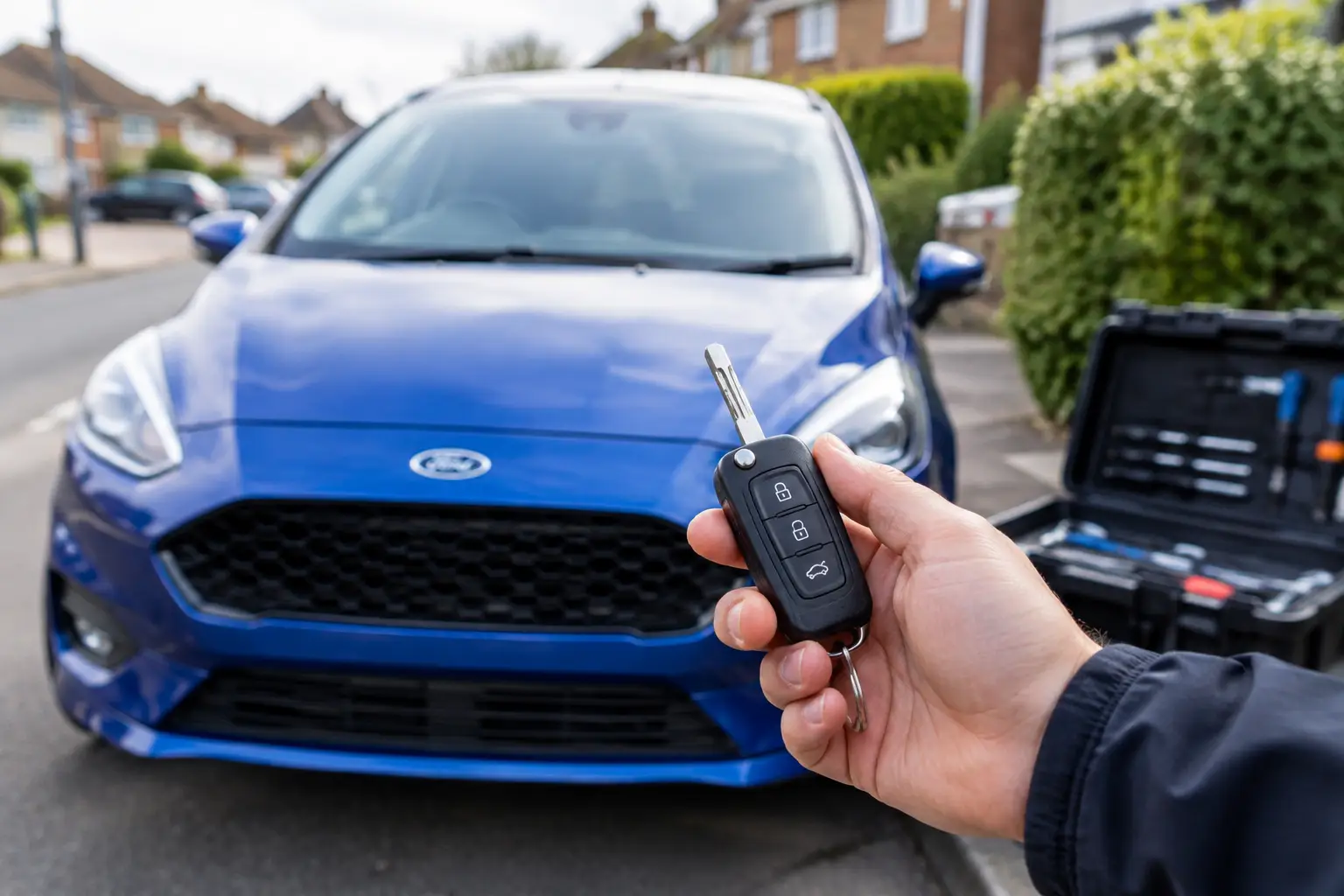
A lost Ford Fiesta key can stop the whole day. Whether you are outside your home, parked at work, finishing a school run or waiting in a car park, Ford Fiesta key replacement is usually more than a simple key-cutting job. The key must physically operate the locks and, on many models, communicate correctly with the vehicle’s immobiliser before the engine will start.
A mobile automotive locksmith can often deal with the problem where the Fiesta is parked, avoiding the extra disruption of arranging vehicle recovery or taking the car to a dealer. The right solution depends on the age of the car, the type of key, what has happened to it and whether you still have a working spare.
Ford Fiesta key replacement: which situation are you in?
The first question is not simply, “Do I need a new key?” It is, “What has failed or gone missing?” A Fiesta owner with one working key has different options from someone who has lost every key, and a key that starts the car but no longer locks it remotely may need repair rather than full replacement.
All Ford Fiesta keys lost
Losing the only key is stressful, particularly when the car is needed for work or family commitments. A replacement key needs to be cut for the vehicle and programmed so the immobiliser recognises it. Depending on the Fiesta’s year and specification, this may involve a conventional transponder key, a remote flip key or a proximity-style key.
A mobile locksmith can assess vehicle compatibility and attend at your location across Birmingham, Coventry, Solihull and nearby areas of the West Midlands and Warwickshire. Proof of ownership and identification will normally be required before replacement work can begin. This protects both the vehicle owner and the vehicle’s security.
If the missing key has been stolen rather than misplaced, ask whether removal of the old key from the vehicle’s security system is supported for your Fiesta. Where possible, this can prevent that missing key from being used to start the car later.
You have one working key left
This is the best time to arrange a spare. It is usually more straightforward to copy and programme an additional key while a working key is available than to wait until the remaining key is lost, damaged or locked inside the car.
For households that share a Fiesta, or drivers who rely on it for commuting, a spare key can remove a great deal of pressure. Keep it somewhere secure and separate from the everyday key, rather than leaving both on the same keyring or inside the vehicle.
The key is damaged, worn or intermittently working
A key does not need to be completely broken to cause trouble. Common warning signs include buttons that only work occasionally, a loose flip blade, a cracked casing, a key that turns poorly in the ignition, or a car that sometimes displays an immobiliser warning and refuses to start.
The cause may be a worn blade, damaged remote casing, flat battery, failing buttons, a displaced transponder chip or an issue with the ignition lock itself. Replacing the battery may help a remote-control problem, but it will not correct a broken blade or a key that the immobiliser cannot recognise. Having the key checked early can be far easier than dealing with a snapped key or no-start situation later.
The type of Fiesta key matters
Ford Fiesta keys changed over the years, so it helps to describe the vehicle accurately when requesting help. The registration number, model year and whether the car has a traditional ignition barrel or push-button start can help establish the likely key type. If you have an existing key, a clear description of its shape and functions is useful too.
Older Fiestas may use a basic-looking key with an immobiliser transponder built into the head. It may have no remote buttons at all, but it still needs correct programming to start the vehicle. Later models commonly use remote keys with lock and unlock buttons, while some newer versions use keyless entry and start systems.
These differences affect the equipment, key blank and programming procedure required. It is why a key cut at a general shop may open the door but still fail to start the car. The mechanical cut and the electronic programming are separate parts of the job.
What happens during a mobile replacement?
The aim is to get you moving again with as little avoidable disruption as possible. After confirming the vehicle details and ownership, the locksmith will establish what type of key or remote is required and whether the relevant parts are available.
For a lost-key situation, the replacement key must be produced for the vehicle and then programmed where required. For a spare, the new key is cut and tested alongside the existing key. A remote key may also need its buttons checked for locking and unlocking operation. The vehicle should be tested before the job is complete, rather than assuming a newly cut key will perform every function correctly.
If you are locked out but the key is inside, non-destructive entry may be possible. Once access is gained, the key can be retrieved and you can decide whether a spare key would be sensible. Avoid forcing a door, levering a window or attempting improvised entry methods. Damage to seals, locks and trim can turn a straightforward lockout into a more expensive problem.
When replacement may not be the only answer
Not every Fiesta key problem calls for a completely new key. A damaged remote shell can sometimes be repaired if the internal electronics are sound. Worn or non-responsive buttons may need attention, while a blade that has snapped in the ignition may require broken-key extraction and inspection of the ignition lock barrel.
Equally, a car that will not start is not automatically suffering from a key fault. If the key is not recognised, an immobiliser-related issue may be involved, but other vehicle faults can produce similar symptoms. A specialist can assess the key, transponder and immobiliser recognition side of the problem where supported, without making assumptions about unrelated mechanical or electrical faults.
This is also why buying a cheap key online can be a gamble. The key may be the wrong frequency, have an unsuitable transponder, use poor-quality buttons or simply not be compatible with the vehicle. Even a compatible aftermarket key still needs correct cutting and programming. A lower upfront cost can become wasted spend if the key cannot be used.
Information to have ready when you call
A quick, accurate description helps a locksmith check suitability and parts availability before travelling. Have the Fiesta registration number ready, plus the model year if known. Explain whether all keys are lost, you need a spare, the remote has stopped working, the key is stuck or broken, or the car will not recognise the key.
It also helps to say where the car is parked and whether it is accessible. A driveway, workplace car park and roadside location can each present different practical considerations. If the vehicle has push-button start, keyless entry or an unusual conversion, mention that at the start.
Pricing should be discussed directly once the vehicle and work required are clear. A proper conversation is more useful than a vague figure because key type, programming needs, travel and available parts can all affect the job.
Avoid making a bad day worse
If you have lost your Fiesta key, retrace your recent steps while arranging help, but do not leave the vehicle insecure or unattended where possible. If the key was stolen, treat it as a security issue as well as an inconvenience. If the key is damaged, stop using it if the blade is bending, the casing is splitting or it is becoming difficult to turn in the ignition.
For Ford Fiesta owners who need practical help at their home, workplace or roadside location, Car Key Maker can discuss vehicle compatibility, current availability and the most suitable next step. Acting while you still have one working key, or at the first sign of key trouble, often gives you more options and less disruption.