
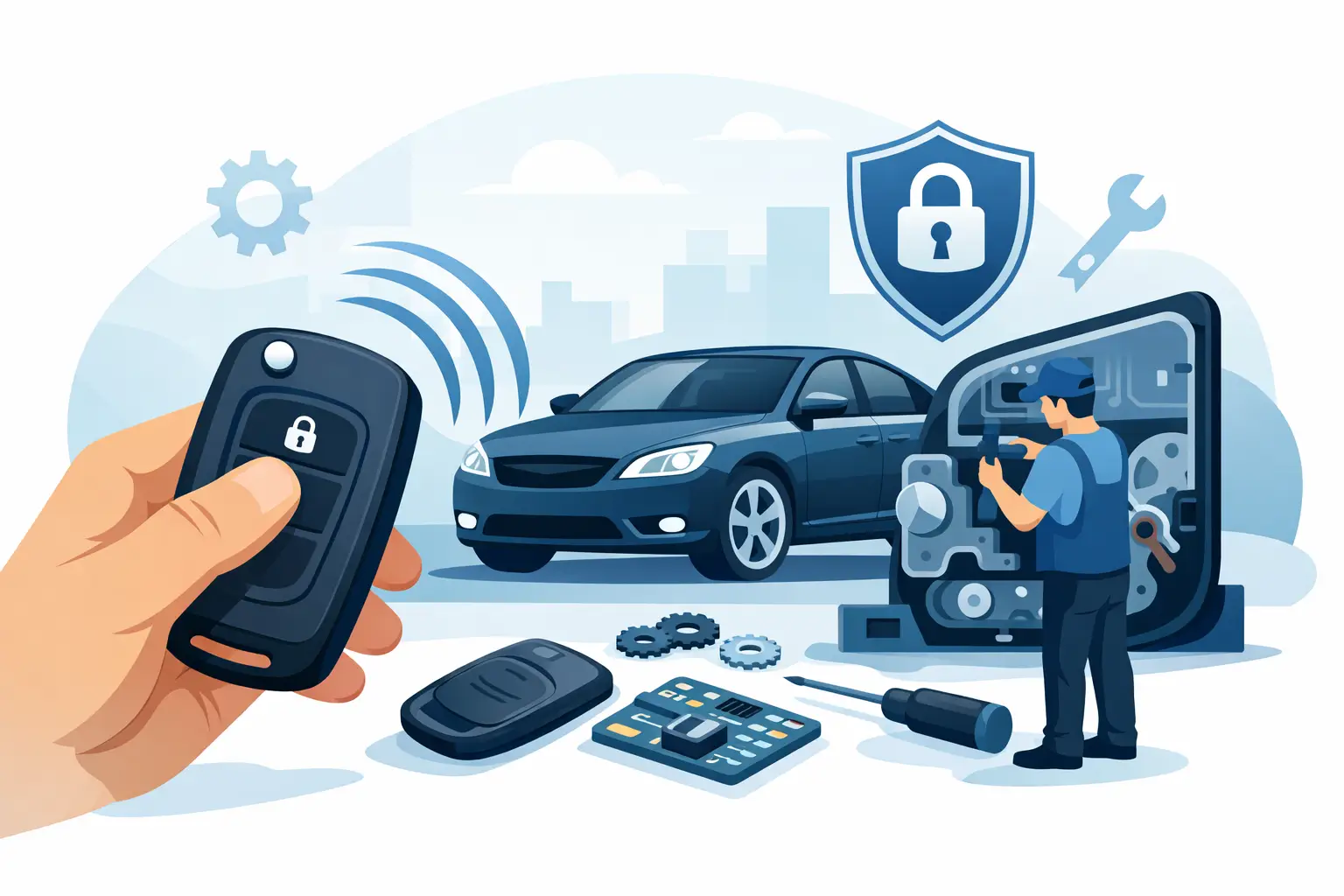
Your car locks worked fine yesterday. Today, the remote does nothing, one door stays shut, or the alarm starts acting up for no clear reason. When that happens, remote central locking repair becomes less of a convenience issue and more of a get-me-back-on-the-road problem.
The tricky part is that central locking faults do not all come from the same place. A dead remote battery can look like a failed key. A weak car battery can cause strange locking behavior. A faulty door lock actuator can make it seem like the whole system has failed when the issue is only in one door. That is why guessing usually costs more time than it saves.
What remote central locking repair actually covers
Remote central locking repair is not one single job. It is a broad fix for any fault that stops your vehicle from locking or unlocking properly from the remote, the key, or the interior controls.
In some cases, the repair is focused on the remote itself. The fob may need a battery, new buttons, soldering work, reprogramming, or a full replacement shell if the internals still work but the casing is damaged. In other cases, the problem sits inside the vehicle, such as a failed actuator, damaged wiring in a door loom, a blown fuse, a body control module issue, or water damage affecting the locking circuit.
That distinction matters because a remote problem is often quicker and cheaper to fix than a vehicle-side fault. But from the driver’s point of view, both feel the same – you press the button and nothing useful happens.
Common signs you need remote central locking repair
Some faults are obvious. Others start small and get worse over time. If your remote works only at very close range, only unlocks some doors, works intermittently, or stops working after the car battery went flat, there is usually an underlying issue worth checking before you end up locked out.
A few patterns show up again and again. One is the remote flashing but the car not responding. That often points to a syncing issue, a weak signal, or a fault in the car rather than the remote battery alone. Another is one door refusing to lock or unlock with the rest. That usually suggests an actuator or mechanical fault in that specific door.
You may also notice the locks cycling repeatedly, the alarm going off unexpectedly, or the key working in the ignition but not operating the remote locking. These symptoms can overlap, which is why proper testing matters more than swapping parts at random.
Why these systems fail
Modern locking systems are convenient, but they rely on several parts working together. The remote has to send a clean signal. The car has to receive it. The control unit then has to trigger each door lock correctly. If one part in that chain fails, the whole system can appear unreliable.
Wear and tear is a big factor. Remote buttons get pressed thousands of times. Circuit boards can crack. Door actuators wear out internally. Wiring in the door hinge area flexes every time the door opens and closes, and over time those wires can break.
Battery issues are another common cause. A weak remote battery can reduce range or stop communication entirely. A weak vehicle battery can confuse electronic systems and create odd symptoms that look like a locking fault. Water ingress is also a regular problem, especially in older vehicles or cars with known drainage issues. Moisture and electronics do not get along.
Then there is programming. If a remote loses sync after a battery change, after electrical work, or after a replacement key is introduced, the fix may be simple reprogramming. But it depends on the make and model. Some cars allow basic resync steps. Others need specialist equipment.
Can you fix it yourself?
Sometimes, yes. But only up to a point.
If your remote central locking has stopped working, the first sensible step is the obvious one – check the remote battery. If the battery is old or the range has been getting worse, replacing it is a low-cost starting point. It is also worth checking whether the spare remote works. If the spare works fine, the fault is likely in the main fob rather than the car.
You can also look for simple clues. If only one door is affected, the problem is less likely to be the remote itself. If the car battery has recently gone flat, charging or replacing that battery may restore normal locking behavior. If a fuse has blown, replacing it may solve the issue, though you still need to ask why it blew in the first place.
Where DIY tends to fall apart is diagnosis. A remote that looks dead may actually be transmitting. A lock that seems jammed may be an actuator fault. A programming issue may need diagnostic tools. Without testing equipment and experience, it is easy to replace the wrong part and still have the same problem.
When a mobile locksmith is the better option
If the car will not lock securely, will not unlock properly, or leaves you relying on the mechanical key alone, speed matters. This is where a mobile auto locksmith usually makes more sense than waiting days for a dealership slot or arranging recovery.
A proper remote central locking repair service should be able to test the key, inspect the lock operation, check whether the remote is transmitting, identify whether the fault is in the fob or the vehicle, and carry out many fixes on-site. That can include replacing remote batteries, repairing damaged remotes, cutting and programming replacement keys, re-syncing remotes, and dealing with some lock and ignition-related faults without the car moving an inch.
That mobile approach is especially useful if the car is stuck at home, in a work parking lot, or outside a store with a fault that showed up without warning. You are not adding towing costs or wasting half a day getting to a dealer. You get the problem looked at where the car already is.
What affects the cost of remote central locking repair
There is no honest one-price answer because the fault could be simple or more involved.
If the issue is just a remote battery or a damaged shell, the fix is usually straightforward. If the remote needs internal repair, replacement, or programming, the cost goes up. If the problem is in a door actuator, wiring, or control unit, labor and parts will vary by vehicle. Some cars are quick to diagnose and repair. Others need more strip-down time or brand-specific programming.
Vehicle make also matters. Basic systems on older cars are often simpler than newer models with encrypted keys, smart entry, integrated alarm systems, and multiple control modules. That does not always mean newer is harder, but it often means there are more variables to test.
The key point is this: paying for accurate diagnosis first is usually cheaper than buying parts based on guesswork.
Dealer or locksmith?
It depends on the fault, but for many drivers, a locksmith is the faster and more practical first call.
Dealerships are fine when the job clearly needs dealer-only parts or software, but they are rarely built around urgency. If you need same-day help, on-site service, or a realistic answer on whether the problem is the key, the lock, or the vehicle electronics, a specialist auto locksmith is often better positioned to help quickly.
A good locksmith also works with the problem as it is, not just with the replacement route. Sometimes a remote can be repaired instead of replaced. Sometimes a lock issue can be isolated to one failed component rather than turning into a bigger bill than necessary. That practical mindset matters when you just need your car working again without the drama.
How to avoid the same problem happening again
Not every fault is preventable, but a few habits help. Replace remote batteries before they fully die, especially if range starts dropping. Keep the remote dry and avoid heavy keychains that put strain on the ignition and key housing. If you notice one door locking slowly or inconsistently, get it checked early before it fails completely.
It also helps to have a spare key that is tested, not just stored in a drawer and forgotten. A spare that actually works can save a lot of stress when your main remote starts failing.
If you are dealing with remote central locking problems now, the best move is not to wait until you are fully locked out or unable to secure the car. Most faults start as warnings. Catch them early, get the right diagnosis, and the fix is usually simpler than leaving it until the day the car decides it is not cooperating at all.