
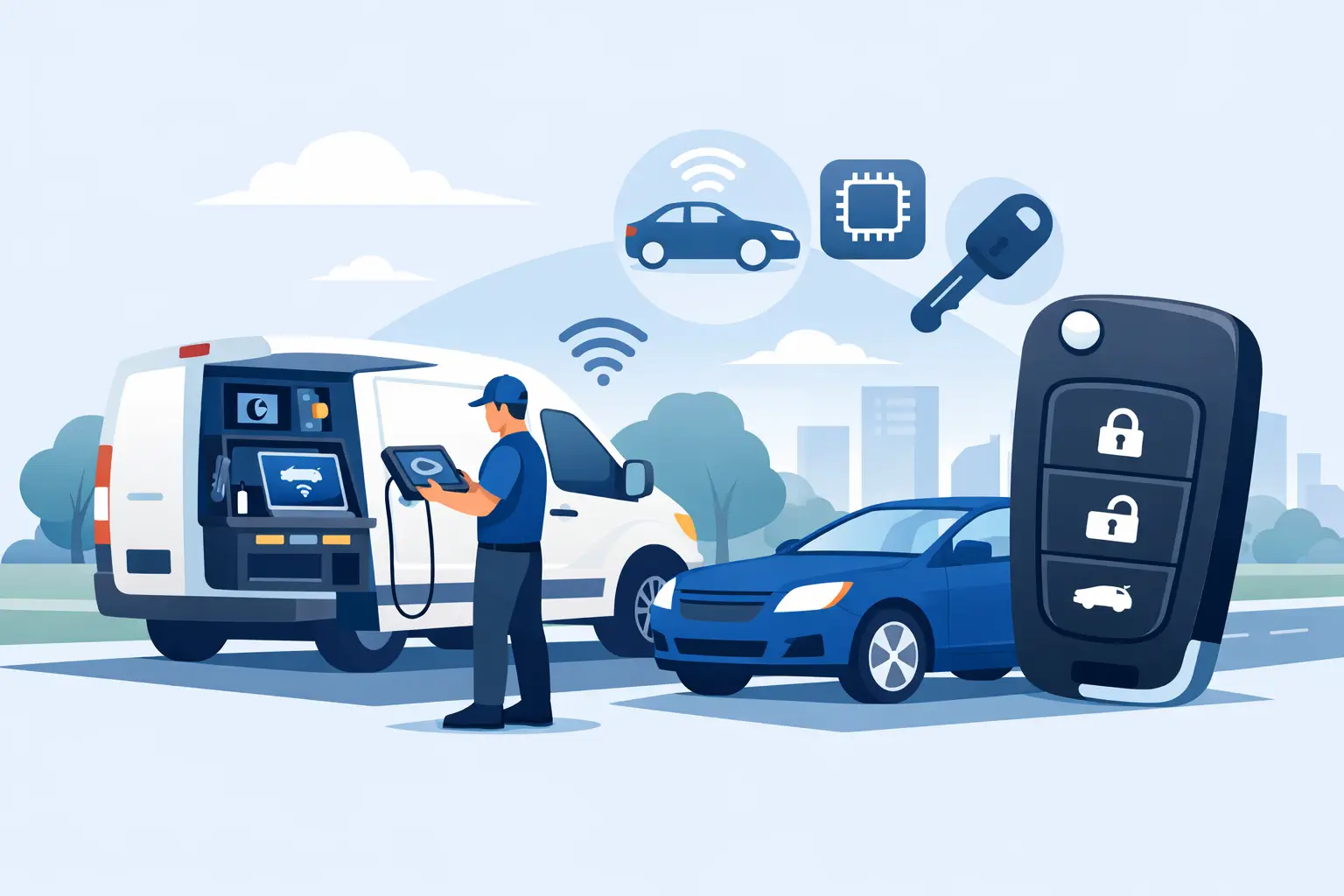
You walk out to your car, press the remote, and nothing happens. Or worse, the car opens but will not start because the immobilizer does not recognize the key. That is usually the moment people start asking how roadside key programming works – and whether it can really be done at the side of the road, at home, or in a work parking lot.
The short answer is yes, in many cases it can. Modern vehicles do not just need a key cut to fit the lock. They also need the electronics inside the key or fob to match the car’s security system. A mobile auto locksmith can often handle that on-site, which saves the time, cost, and hassle of towing the vehicle to a dealer.
How roadside key programming works on-site
Roadside key programming is the process of pairing a new or replacement key, transponder chip, remote, or smart fob to your vehicle while the technician is with the car. The programming tells the vehicle’s immobilizer system that the key is authorized to start the engine. If the remote functions are included, it can also sync lock, unlock, trunk release, and panic functions.
The exact process depends on the make, model, and year. Some vehicles allow relatively straightforward programming through the diagnostic port. Others require security codes, specialist software, PIN retrieval, or manufacturer-specific steps. That is why roadside work is not guesswork. It depends on the right tools, current vehicle data, and experience with different systems.
In practical terms, the technician arrives, confirms ownership, checks the vehicle’s condition, identifies the correct key type, cuts the emergency blade if needed, and then programs the chip or fob so the car accepts it. If the old key is lost or stolen, the job may also include deleting missing keys from the system so they can no longer start the car.
Why modern keys need programming
Older car keys were mostly mechanical. If the cuts matched the lock and ignition, the car would usually start. Most modern vehicles are different. They use transponder chips, proximity systems, encrypted communication, and immobilizers to reduce theft.
That added security is useful, but it also means a basic copy of the blade is not enough. Even if a newly cut key turns in the ignition, the car may still refuse to start if the chip has not been programmed correctly. In push-to-start vehicles, the fob often needs to be recognized by multiple modules before the car will respond normally.
This is also why cheap online keys can be hit or miss. Some are the wrong frequency, some are poor-quality aftermarket shells, and some cannot be programmed to certain vehicles at all. A proper roadside service starts by making sure the replacement key is actually compatible before programming begins.
What a technician actually does during the job
Most customers picture someone plugging in a tool and pressing a few buttons. Sometimes it is that simple. Often it is not.
The first step is identification. The locksmith confirms the vehicle details, key type, and security system. On some jobs, that means checking the VIN, reading lock information, or decoding an existing key if one still works. If all keys are lost, the technician may need to create a key from scratch before any programming can happen.
Next comes key cutting if the replacement includes a physical blade. For many vehicles, that blade still matters because it opens the door or acts as the backup if the fob battery dies. Mobile locksmiths use specialist machines in the van to cut the key accurately on-site.
After that, the programming equipment is connected to the vehicle. This is usually done through the onboard diagnostic port, though the exact method varies. The tool communicates with the car’s immobilizer, body control module, or smart system. Depending on the vehicle, the technician may need to retrieve security data, enter a PIN, place the vehicle into learning mode, or follow a timed sequence.
Once the new key is accepted, every function is tested. That includes locking, unlocking, remote buttons, proximity features, and most importantly, starting the engine. If the job includes deleting old keys, the technician checks that only the current keys remain active.
When roadside key programming is usually needed
This service is not just for people who have lost a key. It is used in a range of everyday problems.
A common one is all keys lost. In that situation, the vehicle cannot be driven anywhere, so mobile help makes the most sense. Another is a spare key that was never programmed properly. You may have a blade that opens the door but does not start the engine. Sometimes the issue is a damaged fob, a failed chip, water damage, or an intermittent immobilizer fault where the car suddenly stops recognizing a key that used to work.
It is also common after theft or a security concern. If a key has gone missing and you do not know who has it, programming a replacement without deleting the missing key is only half a fix. A proper roadside service can often remove lost keys from memory so they no longer work with the vehicle.
What can affect whether it works at the roadside
This is where the honest answer matters. Roadside key programming is possible for many vehicles, but not all jobs are identical.
Some makes and models are straightforward. Others have stronger encryption, restricted security access, or module faults that complicate the process. If the vehicle battery is flat, the ignition barrel is damaged, the immobilizer module has failed, or there is existing electrical damage, programming may not be the only repair needed.
There is also a difference between programming a second spare key and solving an all-keys-lost situation. A spare key job is often quicker because an existing working key can help with identification and access. All-keys-lost jobs usually involve more steps, more equipment, and more time.
The quality of the replacement key matters too. Good programming cannot fix a faulty transponder, incorrect board, or poor-quality shell. That is one reason experienced mobile locksmiths supply tested parts rather than relying on whatever the customer found online.
Dealer vs roadside service
For many drivers, the alternative is a dealership. That route can work, but it often means recovery costs, longer waits, and less flexibility if the vehicle cannot move.
Roadside service is built around the fact that a car key problem usually feels urgent. If you are stuck at home before work, in a supermarket parking lot, or outside a customer site with a van full of tools, you need the problem fixed where the car is. A mobile locksmith brings the cutting equipment, diagnostics, and programming tools to you.
There are trade-offs. Some dealer-only systems can still be more restricted, and there are occasional cases where a module replacement or factory-level intervention is required. But for a large number of common key and fob issues, on-site programming is faster and more practical.
How long roadside key programming takes
People usually want one thing answered first – how soon can I drive again?
The time varies by vehicle and by problem. A straightforward remote or transponder programming job may take less than an hour. An all-keys-lost situation can take longer because the key has to be cut, programmed, and tested from scratch. Smart keys, European models, and vehicles with added security steps may take more time than a basic transponder key.
A good technician will usually tell you early on whether the job looks routine or more involved. Clear expectations matter, especially when you are already stressed.
What you should have ready
If you need help fast, a few details make the process smoother. The technician will usually need your vehicle make, model, year, location, and a clear description of the problem. If you have any working or damaged keys left, keep them nearby. Proof that the vehicle is yours is also important because legitimate locksmiths do not program keys for vehicles without verifying ownership or authority.
If the car has other issues, mention them upfront. A key that will not program may actually point to a deeper fault with the ignition, antenna ring, body module, or battery condition. The more accurate the picture, the faster the right solution can be prepared.
Why experience matters more than people think
Roadside key programming is not just about owning a scan tool. It is about knowing when the problem is the key, when it is the vehicle, and when a so-called simple programming job is actually a security or electrical issue.
That hands-on judgment is what saves time. An experienced mobile specialist can tell the difference between a dead remote battery, a failed transponder, a worn ignition issue, and an immobilizer problem that needs a different fix entirely. That is the difference between changing parts at random and getting the car running properly.
If you are stuck with a car that will not recognize the key, the best roadside help is direct, honest, and set up to solve the problem where you are. That matters most when your day has already stopped and you just need a reliable way to get moving again.