
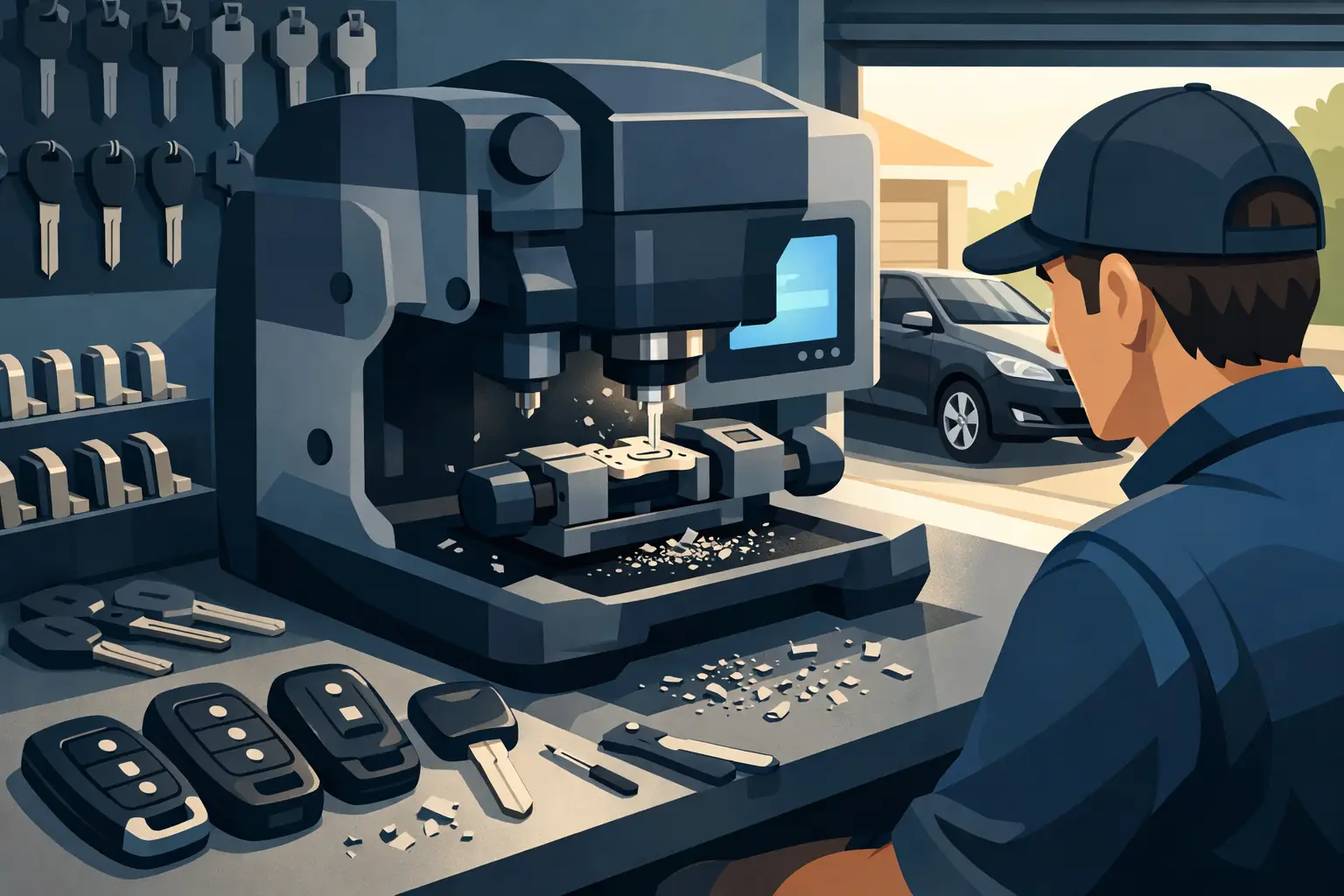
That spare key looks simple until your only working key snaps, goes missing, or starts sticking in the ignition. At that point, knowing how spare car keys are cut matters because the process is not the same for every vehicle, and a bad copy can leave you with a key that turns poorly, fails to start the car, or stops working sooner than it should.
For older cars, cutting a spare key can be straightforward. For newer vehicles, the blade is only part of the job. Many modern keys also need a transponder chip programmed to the vehicle, and smart keys may need remote functions synced as well. That is why some spare keys can be made in minutes, while others take more time, more equipment, and a more exact process.
How spare car keys are cut depends on the key type
The first thing a locksmith checks is what kind of key the vehicle uses. A basic mechanical key with no chip is the simplest version. The cuts on the blade are copied from a working key or generated from key data, then tested in the door and ignition.
A transponder key adds another layer. The metal blade still has to be cut accurately, but the chip inside the head of the key also has to be matched to the car’s immobilizer system. If the chip is missing, incorrect, or not programmed properly, the key may open the doors but it will not start the engine.
Laser-cut keys, sometimes called sidewinder keys, are more precise and usually thicker than older edge-cut keys. Instead of the familiar jagged profile, they have milled grooves cut into the blade. These need a different machine and tighter tolerances. Proximity keys and smart fobs may also include an emergency insert key, which still has to be cut even though the main system is push-to-start.
This is where people get caught out. They assume cutting a car key is the same as copying a house key at a kiosk. Sometimes it is close to that. Often it is not.
The two main ways a spare key is made
A spare key is usually cut in one of two ways. The first is by duplicating an existing working key. The second is by cutting from code.
Duplicating a working key is common when you still have one key that operates the locks properly. The locksmith places the original into a tracing or decoding machine, reads the pattern, and cuts the same pattern into a new blank. This is usually the fastest route, but it depends on the original key being in decent condition. If the key is worn down after years of use, copying it exactly can also copy the wear. That can produce a spare that is technically identical to the old key but not as crisp as a fresh cut should be.
Cutting by code is different. Every vehicle lock is based on a key code or a lock specification. Instead of copying the wear on an old key, the locksmith uses the correct code data and cuts the blade to factory depth and spacing. This often gives a better result when the original key is badly worn, bent, or damaged. It is also the route used when all keys are lost and there is nothing to duplicate.
Neither method is automatically better in every case. If your current key is clean and unworn, duplication can be quick and cost-effective. If the existing key has seen better days, code cutting is usually the smarter choice.
What happens during the cutting process
The actual cutting stage is precise work, not guesswork. First, the locksmith confirms the vehicle details and identifies the correct key blank. Using the wrong blank means the key will never fit or function correctly, even if the cut pattern looks close.
If there is a working key, that key may be decoded to read the cut depths. On some machines, the key is clamped in place and traced mechanically. On newer computerized equipment, the machine reads the pattern and cuts the blank with high accuracy. If there is no working key, the locksmith may retrieve the key code from manufacturer data, specialist software, or by decoding the lock directly.
Once cut, the new blade is checked physically in the door lock, ignition, or both, depending on the vehicle. A good locksmith does not just hand over a fresh-cut key and hope for the best. The key should insert smoothly, turn cleanly, and feel right. If there is resistance, it may need refining before the job is finished.
That testing stage matters. A key that needs to be forced is not a good spare. Over time, that can wear the lock, damage wafers inside the ignition, or leave you stranded when the key suddenly stops turning.
Why programming is often part of the job
People often ask how spare car keys are cut when what they really need to know is why the new key still will not start the car. The answer is usually the transponder chip.
Most modern vehicles have an immobilizer system designed to prevent theft. The system looks for a recognized chip inside the key. If the chip is not present or not programmed to the vehicle, the engine control system blocks starting. So even when the blade is cut perfectly, the car may crank and die, or not crank at all.
Programming tools connect to the vehicle and add the new key into the system. On some makes, this is quick. On others, security procedures are stricter and can take longer. Some vehicles also limit how many keys can be stored at one time, or require old lost keys to be removed from the system for security.
This is one reason dealership quotes can climb fast. The work is no longer just cutting metal. It is key generation, chip programming, remote syncing, and security management in one job.
Why cheap copies sometimes fail
Not all spare keys are made to the same standard. A low-cost copy can look fine in your hand and still cause problems later. The most common issue is inaccurate cutting. If the machine is out, the blank is poor quality, or the original key was too worn to duplicate properly, the result may be a key that works only occasionally.
Another issue is poor-quality chips or remotes. Some aftermarket options are perfectly serviceable. Others are unreliable, have weak buttons, or lose programming sooner than they should. That does not mean every budget key is bad. It means the source, the equipment, and the person doing the work all matter.
There is also the risk of treating every key like a simple duplicate. On some cars, a worn ignition or damaged lock means the problem is not the key at all. Cutting another copy will not fix an ignition barrel that is already failing. A proper locksmith will spot that before you waste money on the wrong repair.
When a mobile locksmith makes more sense
If you have one working key and just want a backup, you may have a few options. But if the car will not start, all keys are lost, or the existing key is broken, mobile service usually makes more sense than towing the vehicle anywhere.
An automotive locksmith can cut and program many keys on-site, test them on the vehicle, and deal with lock or ignition issues at the same time if needed. That saves time and often cuts out the extra cost and delay that come with dealership bookings or vehicle recovery.
That convenience matters most in real-world situations, not ideal ones. You are at work, on your driveway, outside a store, or stuck with school pickup coming up. You do not need a theory lesson. You need the right key made properly, there and then.
Can any spare key be copied?
Not always. Some keys are too worn, cracked, or damaged to duplicate accurately. Some remotes have failed internally. Some vehicles use encrypted systems that require specialist programming tools and verified procedures. And if the locks have been changed before, the vehicle may not match the original factory key data.
That is why inspection comes first. A locksmith needs to know whether the existing key is a reliable source, whether the lock is healthy, and whether the vehicle will accept another key without extra steps. In a lot of cases, yes, a spare can be made quickly. In others, the right answer is to cut from code, program a new chip, or sort the lock fault first.
A spare key is always cheaper and easier to make before you are down to your last one. That is the practical truth. If your only key is worn, taped together, or intermittently failing, do not wait for it to become an emergency. Get it checked while the job is still simple, and you will save yourself a much bigger headache later.