
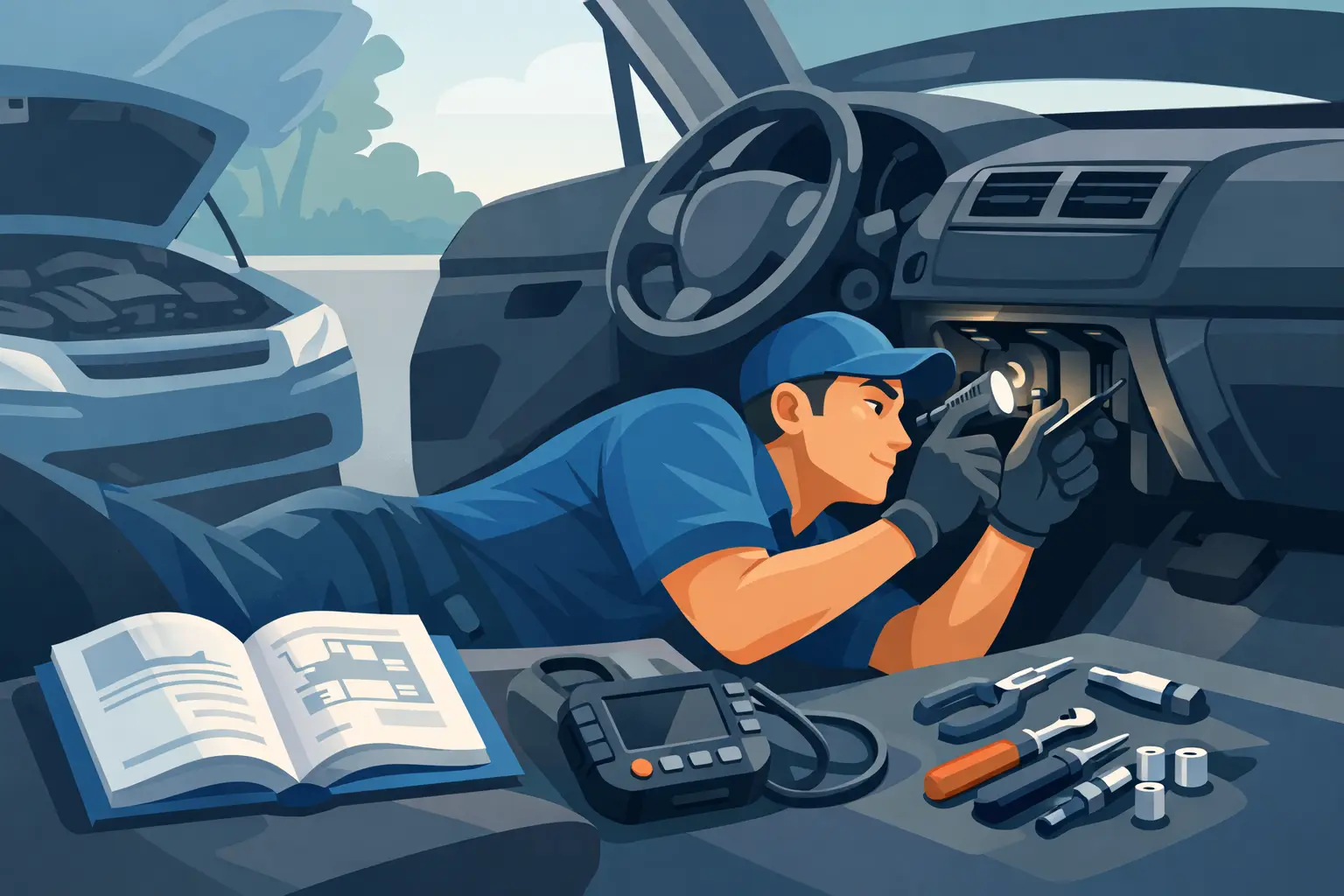
You turn the key, it resists, and suddenly a simple school run or work trip turns into a problem. If you are searching for how to fix sticky ignition, the first thing to know is this: forcing it usually makes it worse. A sticky ignition can go from annoying to fully jammed very quickly, especially if the key or ignition barrel is already worn.
Most sticky ignitions start with one of three causes. The key is worn, the steering lock is putting pressure on the cylinder, or the ignition barrel has dirt, wear, or internal damage. The right fix depends on which of those you are dealing with. Some cases are simple enough to sort on the spot. Others need a locksmith before the key snaps or the ignition fails completely.
Why an ignition gets sticky in the first place
Your ignition is a lock, and like any lock, it relies on very small internal parts lining up properly. Over time, the cuts on the key wear down. That means the pins inside the ignition no longer line up as cleanly as they should. The result is a key that only works after a wiggle, works only in one direction, or feels rough when turning.
There is also the steering lock to consider. If the wheel is turned hard against the curb or under tension, it can put pressure on the ignition mechanism. In that case, the key feels stuck, but the real issue is not the key itself.
Then there is internal wear. Ignition barrels handle years of daily use, and eventually springs, wafers, and other small parts start sticking or wearing unevenly. Dirt and old lubricant can make that worse. If the problem has been building for weeks or months, that wear is often the real cause.
How to fix sticky ignition without making it worse
Start with the safest checks first. Do not yank the key, do not hammer it, and do not spray random household lubricants into the ignition. Those quick fixes often create a bigger repair.
Check for steering lock pressure
If the steering wheel feels locked, place one hand on the wheel and gently move it left and right while lightly turning the key with your other hand. Do not force either one. You are trying to release pressure, not overpower the lock.
This works surprisingly often. If the wheel was under tension, the ignition may turn normally as soon as that pressure comes off.
Inspect the key carefully
Look at the key blade in good light. If it appears rounded off, bent, cracked, or heavily worn, that may be your problem. A worn key can still open the door but struggle in the ignition because the ignition often has tighter wear points.
If you have a spare key, try that next. If the spare works smoothly, stop using the worn key. This is one of the clearest signs that the key is the issue rather than the ignition barrel.
If you do not have a spare, a proper new key cut to the correct standard usually works better than another copy made from an already worn key. That distinction matters. A bad duplicate can keep the problem going.
Try gentle key movement only
Insert the key fully, then ease it back by a tiny amount and try turning again. Sometimes the key is bottoming out slightly differently than the wafers expect, especially on a worn ignition. A very light wiggle can help, but this should be controlled and minimal.
If you have to fight with it, stop. Repeated twisting can snap the key in the ignition, and that turns a repair into an extraction job.
Use the right lubricant, if any
If the ignition feels dry or gritty, a graphite-based lock lubricant or a specialist product designed for locks can help. Use a small amount. More is not better.
Avoid heavy oils and general-purpose sprays that leave residue behind. They may free it up for a day, but they also attract dirt and can gum up the internal parts. That is a common reason a slightly sticky ignition turns into a badly jammed one later.
Check for dirt or debris on the key
It sounds basic, but keys spend time in pockets, bags, vans, and glove boxes. Dirt on the blade can transfer into the ignition over time. Wipe the key clean and try again. If the key has burrs or visible damage, do not file it down unless you know exactly what you are doing. Removing metal from the wrong area can make the key unusable.
Signs the ignition barrel itself is failing
If you are still dealing with the same problem after trying the basics, the barrel may be worn internally. That is especially likely if the key only turns after several attempts or if it sticks in certain positions.
Common warning signs
A failing barrel often shows itself in patterns. The key may go in but not turn. It may turn part way and stop. It may need to be jiggled every time. In some cases, the key gets stuck when you try to remove it, or the dash powers up inconsistently.
Another red flag is when the problem happens with more than one key. If both your main key and spare struggle in the same way, the ignition is usually the culprit.
At that stage, you are past the point of a simple quick fix. The goal shifts from freeing it up today to preventing a full failure.
When not to keep trying
There is a point where more effort does more harm than good. If the key is bending, if it feels like it might snap, or if the ignition has completely seized, stop trying to force it. Broken keys inside ignitions are common, and once that happens, the repair becomes more involved.
The same applies if your car uses a transponder key and you are also seeing immobilizer issues. A sticky ignition and an electronic key problem can happen at the same time, but they are not the same fault. Swapping parts or guessing can waste time and money.
When a locksmith is the smarter fix
This is where experience matters. A qualified auto locksmith can tell whether the issue is the key, the barrel, the steering lock, or a mix of them. More importantly, they can usually deal with it on-site instead of sending you down the towing and dealership route.
For a lot of drivers, that is the real difference. If your ignition is sticking outside work, at home, or in a parking lot, you do not need theory. You need the car moving again without making the problem worse.
An automotive locksmith can cut and test a proper replacement key, repair or replace the ignition barrel, remove a broken key, and check whether the fault is mechanical or tied to the immobilizer system. If you are in the West Midlands or Warwickshire area, a mobile specialist such as Car Key Maker can often do that same day at your location, which is a lot easier than arranging recovery.
How to prevent a sticky ignition from coming back
Once the issue is sorted, a few habits help prevent a repeat. Use a good key, not a worn-out copy that has been struggling for months. Keep your keyring light if possible, since heavy keychains can add wear over time. If the ignition starts feeling rough again, deal with it early instead of waiting for a total failure.
It also helps to pay attention to patterns. If it sticks more when the wheel is turned sharply, steering lock pressure may be part of it. If it is getting worse week by week regardless of wheel position, internal wear is more likely.
That difference matters because prevention is cheaper than emergency repair. A key cut at the right time or an early barrel repair is usually far less hassle than dealing with a car that will not start at all.
A few fixes people try that usually backfire
People often reach for the nearest spray can, twist harder, or keep retrying until the key finally turns. That can work once or twice, but it is not a real fix. It just buys time while the wear gets worse.
Another common mistake is having a new key copied from a badly worn original. If the source key is already inaccurate, the copy often repeats the same problem. That is why a properly decoded or correctly cut key is often a better long-term answer.
And if your key is already cracked near the head or blade, do not keep using it in a sticky ignition. That is exactly how keys snap under load.
The practical answer to how to fix sticky ignition problems
If the wheel is locked, release the steering pressure first. If the key is worn, use the spare or get a proper replacement. If the ignition feels dry, use only a lock-safe lubricant in a small amount. If it still sticks, or if it has been getting worse for a while, treat it as an ignition barrel problem and get it looked at before the car leaves you stranded.
A sticky ignition is one of those faults that gives warnings before it fails completely. That is the good news. The helpful move is to act while the key still comes out and the car still starts, because that is usually the point where the fix is quickest, cheapest, and least disruptive.