
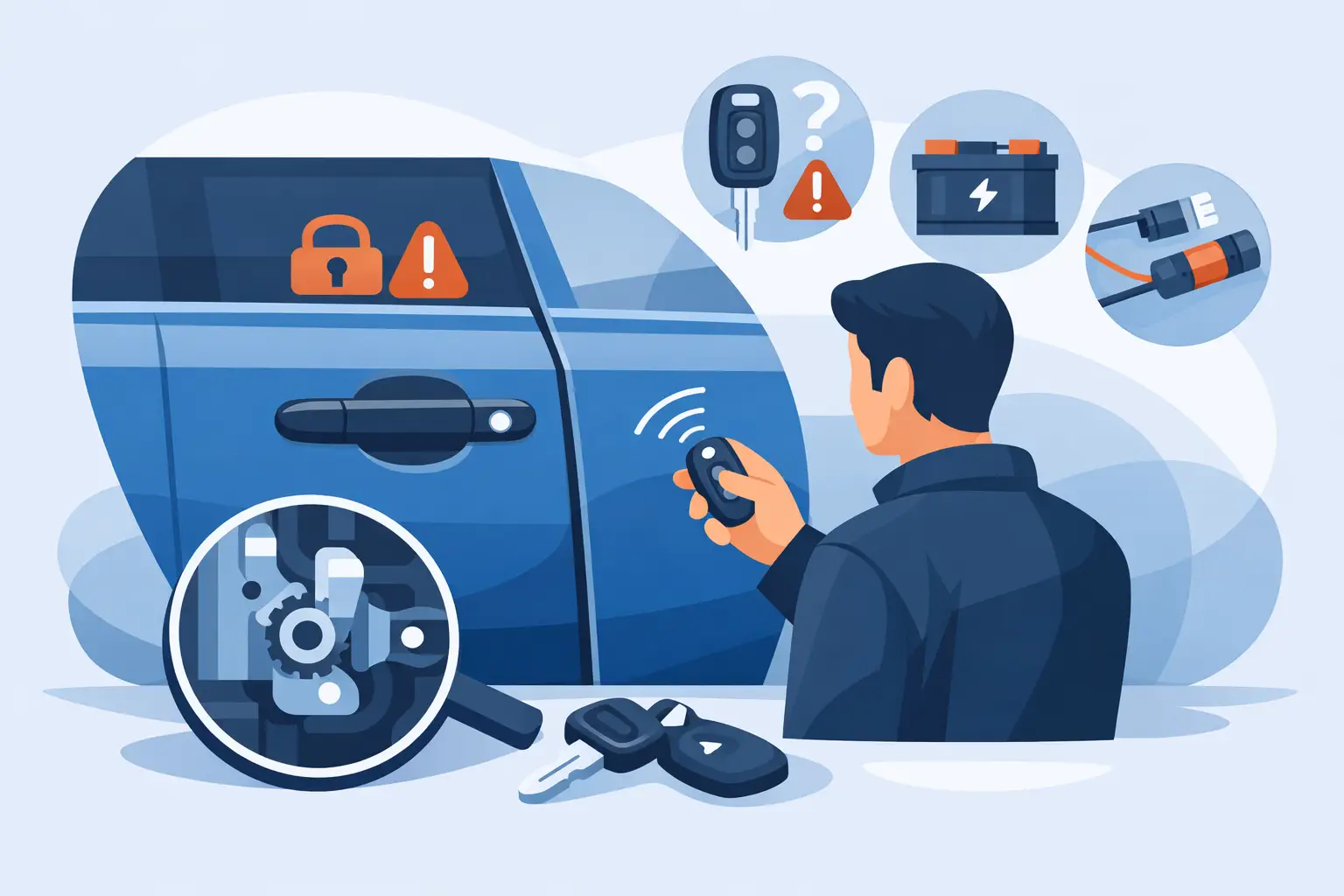
You walk up to the car, press the remote, pull the handle, and nothing happens. If your car door wont unlock, the problem can be as simple as a dead key fob battery or as frustrating as a failed door lock actuator. Either way, the main thing is to avoid making it worse by forcing the handle, twisting the key too hard, or prying at the door.
Some lock problems are quick fixes. Others point to a fault inside the door, the key, or the vehicle’s security system. The right next step depends on one detail – is the issue affecting one door, all doors, or only certain ways of opening the car?
When a car door wont unlock, start with the pattern
Before you try anything else, take ten seconds to notice what is and is not working. That saves time and can stop a small issue from turning into a broken lock, snapped key, or damaged trim.
If none of the doors respond to the remote, the problem is often with the key fob battery, the vehicle battery, or the central locking system. If one door will not open but the others do, that usually points to a mechanical fault in that specific door. If the key turns but nothing happens, the lock mechanism may be worn or disconnected. If the key does not turn at all, the lock cylinder may be jammed, frozen, or damaged.
That distinction matters because the fix for a weak remote is very different from the fix for a failed actuator buried inside the door.
The most common reasons your car door wont unlock
A dead or weak key fob battery is one of the most common causes. People often assume the car has a major lock fault when the remote simply is not sending a strong enough signal. Sometimes you will notice reduced range first. Other times it stops working all at once.
A flat vehicle battery can cause the same confusion. If the car has no power, central locking may not respond at all. On some vehicles, the mechanical key should still open the door, but not always if that lock has not been used in years and has seized up.
A worn key is another frequent problem. Over time, the cuts on the blade wear down. The key may still start the ignition on some older vehicles or work occasionally in one lock but not another. That inconsistency is usually a warning sign, not bad luck.
Then there is the lock itself. Dirt, corrosion, internal wear, and failed components inside the latch can stop the door from opening. Modern vehicles also rely on actuators, wiring, and control modules. When one of those fails, the door may stay locked even though the rest of the car responds normally.
In colder weather, ice can be the issue. In hotter weather, swollen seals or sticky internal parts can add resistance. And after accident damage, even minor damage, door alignment can affect how the latch and lock behave.
What you can safely try first
Start with the simple checks. If you have a spare remote, test it. If the spare works, your main key fob is the likely problem. If neither remote works, try the mechanical key if your vehicle has one.
If the mechanical key will not go in smoothly, do not force it. That can bend the key or damage the lock cylinder. If it goes in but feels stiff, a lock may be seized or dirty. Gentle pressure is one thing. Leaning your body weight into it is another.
If one door will not open, try another door or the trunk. On some vehicles, you can gain access through a different opening and work the affected door from inside. If the inside handle also fails, that points more strongly to an internal latch or lock fault rather than a remote issue.
Check the car battery if the whole vehicle seems dead. No interior lights, no response from the fob, and no dashboard activity all suggest a power issue. In that case, the door lock problem may be a symptom rather than the root cause.
If the weather is freezing and the key or lock feels icy, avoid pouring hot water on the door. That can create more problems fast. A frozen lock needs a careful approach, not a quick gamble.
What not to do
This is where many lockouts get more expensive.
Do not wedge screwdrivers or metal tools into the door frame. It is very easy to bend the frame, tear the weather seal, scratch paint, or damage side curtain airbag areas. Do not yank the outside handle repeatedly if it feels loose or stuck. If a linkage clip inside the door has already failed, more force will not fix it.
Do not keep twisting a key that is struggling to turn. Worn or weak keys can snap, and once the blade breaks in the lock, the job gets more complicated. The same goes for folding keys with damaged hinges. If the key feels unstable, stop.
DIY sprays can also be hit or miss. A proper lock lubricant may help in some cases, but the wrong product can attract dirt or gum up the cylinder over time. If the lock is already damaged inside, spray alone will not sort it.
Signs you need a locksmith instead of trial and error
If the key is stuck, the key will not turn, the remote is not responding, and you cannot access the vehicle through another door, it is usually time to get professional help. The same applies if you have children, pets, medication, or essential work tools inside the car. At that point, speed matters more than guesswork.
A mobile auto locksmith can usually tell very quickly whether the issue is the key, the lock, the latch, the central locking system, or the vehicle battery. That matters because a lot of drivers assume they need a replacement key when the real problem is inside the door. Others assume the door is broken when the fob has simply failed.
If all keys are lost, stolen, or locked inside, a specialist can also handle more than just entry. Depending on the vehicle and fault, they may be able to cut and program keys, repair damaged remotes, deal with broken key blades, and diagnose ignition or immobilizer-related issues on-site.
Why one locked door can be harder than a full lockout
It sounds backward, but a single jammed door can sometimes be more awkward than a car that is completely locked. If the affected door has a failed latch or actuator and it will not respond from either handle, getting it open without damaging trim or hardware takes experience.
That is especially true on newer vehicles where access is tighter and electronic components are more sensitive. There is no universal trick that works on every make and model. What works on an older sedan may be the wrong move on a newer SUV with deadlocks or extra security features.
This is also where cheap fixes can waste time. Replacing a key fob battery will not repair a broken actuator. Smacking the door might make a failing part move once, but it is not a real repair and can leave you stranded again the next day.
Can a dealership fix it?
Sometimes, yes. But if your car door wont unlock and you cannot even get into the vehicle, getting it to a dealership is its own problem. That often means towing, waiting for a booking, and paying main dealer rates before the actual repair even starts.
A mobile auto locksmith is usually the more practical first call when the problem is immediate access. You get help where the car is parked, whether that is at home, at work, or in a store lot. If the issue turns out to be key-related, lock-related, or tied to the ignition barrel, it can often be handled on-site without the delay and cost that come with dealership visits.
For drivers who need the car for school runs, work calls, deliveries, or commuting, that time difference matters. Fast response is not just a convenience when you are stranded. It is the difference between losing an hour and losing a day.
The fastest way to avoid this happening again
Use your spare key before it becomes an unknown. A spare that has sat in a drawer for years may have a dead battery or outdated programming. Replace weak fob batteries early, not after total failure. If your key feels worn, sticky, or inconsistent, get it checked before it stops working completely.
Pay attention to early warning signs. Reduced remote range, a key that only works after a few tries, a stiff door lock, or one door acting differently from the others are all signs that something is starting to fail. Catching it early is usually cheaper and far less stressful than dealing with a lockout in the rain, in the dark, or when you are already late.
If you are stuck and need a fast, practical fix, Car Key Maker deals with exactly these problems on-site. The main thing is not to force a bad lock into becoming a broken one. A careful first step usually saves money, damage, and a bigger headache later.