
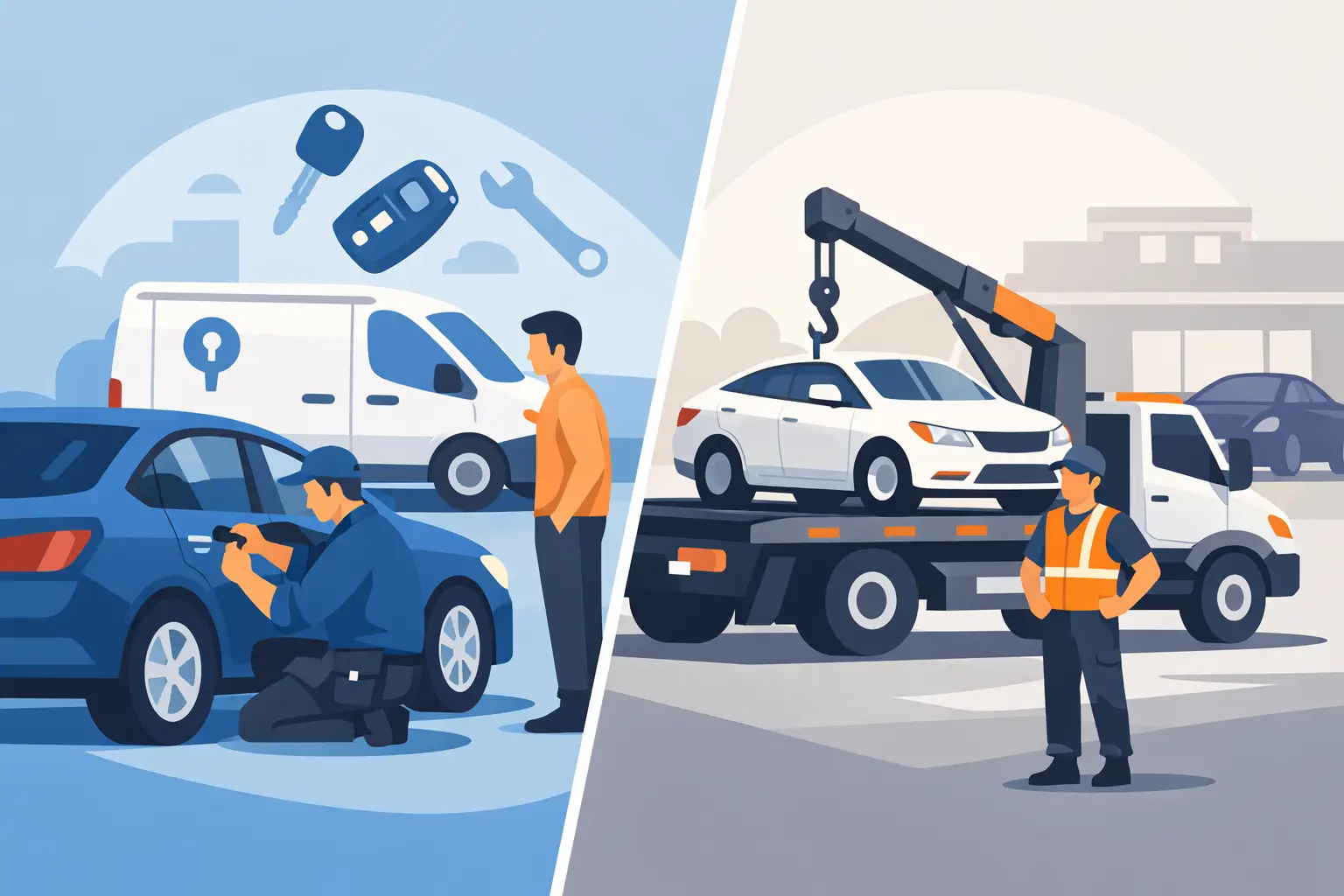
Your car is stuck in a parking lot, your keys are missing, and the first decision matters more than most drivers realize: mobile locksmith vs dealer towing. Make the wrong call and you can lose half a day, pay for a tow you did not need, and still wait longer than expected to get back on the road.
For most key and lock problems, a mobile auto locksmith is the faster and more practical option. But not every situation is the same. Some vehicles, some security issues, and some warranty cases can still push you toward a dealer. The smart move is knowing which service actually fits the problem in front of you.
Mobile locksmith vs dealer towing: what is the real difference?
A mobile auto locksmith comes to your vehicle and handles the work on-site. That usually includes car key replacement, key duplication, lockout service, remote issues, ignition barrel repair, and in many cases programming a replacement key to the vehicle.
Dealer towing works differently. If your car cannot be driven because the key is lost, broken, or not recognized, the vehicle often has to be towed to the dealership first. Only then does the diagnostic and key ordering process begin. That extra step changes the cost, the timing, and the amount of hassle involved.
This is why the comparison is not just locksmith versus dealer. It is usually locksmith on-site versus dealer plus tow truck plus scheduling delay.
When a mobile locksmith usually makes more sense
If all keys are lost, you are locked out, the key snapped in the lock or ignition, the remote stopped working, or the ignition barrel is worn, a mobile locksmith is often the most direct fix. These are field-service problems by nature. The vehicle is already where it is, and the technician brings the tools, blanks, programming equipment, and repair knowledge to you.
That matters when you are at home before work, outside a grocery store with kids in the car park, or standing beside a work van that cannot move. Most people do not care where the fix happens. They care how quickly they can leave.
A good mobile locksmith also cuts out the wasted step of recovery. If the vehicle can be repaired and keyed where it sits, towing becomes an avoidable expense rather than part of the solution.
In urgent situations, this is usually the biggest advantage. Same-day response is not a luxury when your car is your commute, your school run, or part of your business.
Cost is not just the invoice
Drivers often assume a dealer is the official option and therefore the safest one. That may be true in a narrow sense for some manufacturer-specific cases, but it does not mean it is the most cost-effective route.
With dealer towing, the real bill often comes from several moving parts. There is the towing charge, the dealership labor rate, possible diagnostic fees, and in some cases a delay while a key is ordered. If the vehicle is off the road for days, there is also the hidden cost of missed work, rearranged plans, rental cars, or relying on someone else for transportation.
A mobile locksmith typically removes at least one major cost immediately: towing. In many common situations, that changes the whole math. Even if the key itself is not cheap, avoiding transport, extra scheduling, and multiple appointments often makes the overall solution far more realistic.
That is especially true with older cars, everyday family vehicles, and work vans where the owner needs a practical fix, not a long process.
Speed matters more than people expect
Most key emergencies are not dramatic until they start eating time. What feels like a simple lost-key problem at 8 a.m. can become a missed shift, a canceled appointment, or a stranded customer by noon.
A mobile locksmith is built for that reality. The job starts where the vehicle is. There is no waiting for a tow slot, no separate handoff to a service department, and no need to arrange transport just to begin diagnosis.
Dealers are not designed around roadside urgency. They are designed around workshop scheduling. That does not make them bad. It just means their process often moves at a different pace than the customer needs in an emergency.
If your priority is getting the car moving again as fast as possible, on-site service usually has the edge.
Mobile locksmith vs dealer towing for lost all keys
This is one of the clearest examples. If you have lost all keys, the vehicle is effectively immobilized. A dealer may be able to supply a replacement, but the car often has to reach them first. That can turn one problem into two.
A qualified mobile auto locksmith can often generate, cut, and program a replacement key at the vehicle. On many makes and models, that means the problem is solved without ever moving the car.
There is another advantage here that drivers overlook: security. If keys were stolen rather than simply misplaced, a locksmith may be able to delete old keys from the system and, where needed, change locks. That is a practical response when you are worried someone else may still have access to the vehicle.
A dealership may also handle parts of this, but the mobile option is often more immediate and more suited to the urgency of the situation.
When the dealer may still be the better call
There are cases where a dealer is the right move. If the issue goes beyond keys and locks and points to a deeper manufacturer-specific electronic fault, a dealership may have model-specific systems and factory procedures that make sense. The same applies if the vehicle is under a warranty plan that requires dealer involvement.
Some very new or high-security vehicles can also be more restrictive. Certain brands use tighter programming controls, and access to replacement credentials may be more limited. In those situations, an experienced mobile locksmith will usually tell you plainly if dealer involvement is necessary.
That honesty matters. The best service is not about forcing every job into one solution. It is about getting you to the right fix without wasting your time or money first.
The convenience gap is bigger than it sounds
People hear the word convenience and think it means a minor perk. In vehicle key emergencies, convenience is often the whole point.
If you are at home, a mobile locksmith can work on the drive. If you are at work, the repair can often happen in the parking lot. If the car is stuck at a shopping center, on a side street, or outside a school, the technician comes to that location. That saves time, but it also reduces stress because you are not trying to organize a recovery, a ride, and a service appointment at the same time.
For parents, commuters, and tradespeople, that difference is hard to overstate. The less your day gets rearranged around the problem, the better the service has done its job.
What to ask before you choose
Before agreeing to a tow or booking a service, ask a few direct questions. Can the issue be handled on-site? Can a replacement key be cut and programmed where the car is? If the ignition is the problem, can it be repaired rather than replaced? If keys were stolen, can old keys be erased from the system?
The answers will tell you quickly whether you need transport to a dealer or whether you are looking at a mobile job. A reliable locksmith should also be clear about timing, coverage, and price before the work starts.
That clarity matters when you are already stressed. You do not need vague promises. You need to know who can solve the problem today.
The practical answer for most drivers
In a straight mobile locksmith vs dealer towing comparison, the mobile locksmith usually wins on speed, convenience, and total cost for common car key and lock issues. That is especially true when the vehicle is stranded only because of the key, remote, lock, or ignition barrel.
The dealer still has a place, particularly for certain new vehicles, warranty claims, or manufacturer-level electronic faults. But for everyday emergencies, towing the car somewhere else is often the long way around a problem that can be fixed where the vehicle already sits.
If your car will not start because the key is lost, broken, locked inside, or no longer working properly, the best next step is usually the most direct one: get someone to come to the vehicle and solve it there. When the right help arrives fast, the whole situation gets smaller.