
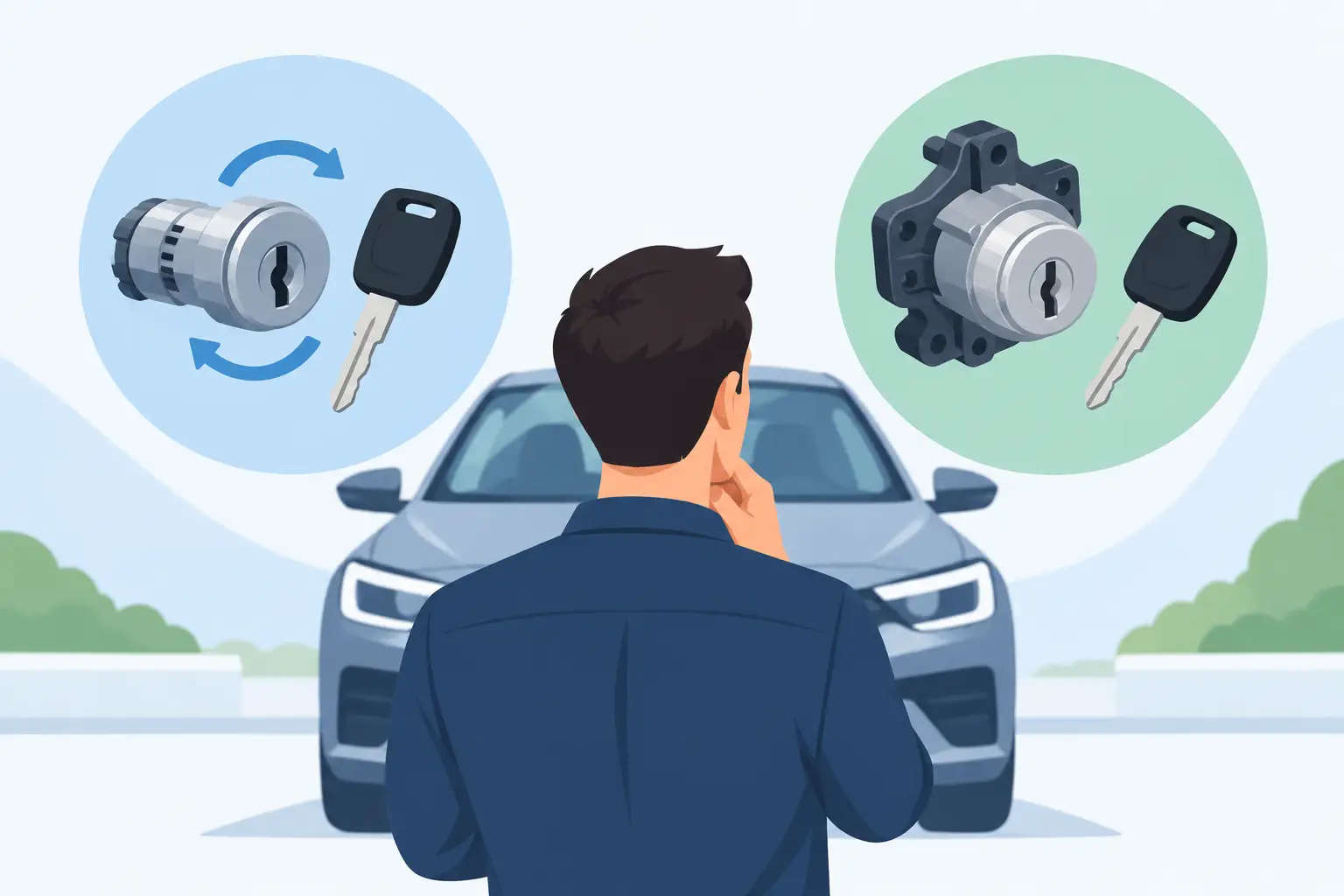
Whether to rekey car locks or replace them is not a decision to guess at, especially when a lost, stolen or damaged key has left you worried about who can access your vehicle. The right fix depends on what has happened to the key, the condition of the lock barrels and whether the vehicle’s electronic key system is also at risk. A proper inspection gives you a clear answer and gets the work completed where the vehicle is.
Rekey car locks or replace them: what is the difference?
Rekeying changes the internal configuration of a lock barrel so that it operates with a different mechanical key. The outside of the barrel may remain in place, but an old key should no longer turn it. This is usually considered where the lock itself is sound but security has been compromised by a missing key.
Replacing a lock means fitting a new or replacement barrel because the existing one is worn, damaged, seized or unreliable. A replacement may be needed for one door, the boot, the ignition, or more than one lock depending on the fault and the vehicle.
These jobs are often confused because both involve keys and access. However, the cause of the problem matters. If a key is simply worn out, the answer could be a correctly cut new key. If somebody has stolen the key, changing the physical locks and dealing with the vehicle’s electronic authorisation system may both be necessary.
When rekeying is the sensible option
Rekeying is most useful when the lock barrels are in good working order but you do not want an old mechanical key to operate them. For example, you may have lost a spare key in an unknown place, had keys taken with personal documents, or bought a used vehicle with no certainty about how many old keys remain in circulation.
A locksmith can assess whether the vehicle’s barrels can be reconfigured or whether matched replacement components are the better route. On some vehicles, the practical solution is to supply and fit lock barrels that work from a newly cut key rather than alter the original barrel internally.
The key point is that rekeying addresses physical access. If an old key can turn a door lock, rekeying or replacing that barrel prevents that particular blade from operating it. It does not automatically deal with a remote fob, transponder chip or keyless entry function.
That distinction matters after theft. A thief may be able to open a door with the mechanical blade, start the vehicle with a programmed transponder, or both. Each part needs checking rather than assuming one repair covers everything.
When car lock replacement is the safer repair
Replacement is usually the right call when a lock has failed physically. Common signs include a key that will not turn, a barrel that spins without operating the lock, a key that needs jiggling to work, or a lock that has been forced during an attempted break-in.
A damaged barrel can leave you stranded in a very ordinary situation. You might return to the car after work, find that the remote battery has failed, then discover the mechanical door lock will not accept or turn the key. The remote may have hidden the fault for months.
Replacement is also appropriate if the key has snapped in the barrel, the keyway is badly worn, or corrosion has affected the internal parts. Continuing to force a sticking key can make a manageable repair into a complete lock failure. If the key feels wrong, stop before it breaks and have the lock checked.
Ignition barrels need particular care. A worn ignition can cause a key to stick, fail to turn or return poorly after starting. On vehicles with immobiliser systems, the mechanical ignition repair and the electronic programming work must be handled correctly so the vehicle remains secure and starts as it should.
A new key does not always solve a security problem
Many modern vehicle keys perform more than one job. They can contain a remote-control board, a transponder chip for the immobiliser and a mechanical blade for the door or ignition. That means there are separate layers of vehicle security.
If you lose a key but still have a working spare, getting another key cut and programmed restores your convenience. But if the missing key may have been stolen, simply adding a new one may leave the old programmed key active in the system. The old key could still start the vehicle if it is used with the correct lock or if the vehicle has keyless starting.
In that situation, old keys should be removed from the vehicle’s memory where possible. This prevents a missing transponder or remote from being recognised by the car. If there is a risk that the person with the old key knows which vehicle it belongs to, discuss both key deletion and physical lock security with your auto locksmith.
For keyless vehicles, the mechanical emergency blade should not be overlooked either. It may be rarely used, but it can still provide access through the door barrel. A complete security solution considers the blade, remote function, immobiliser authorisation and any lock damage together.
Warning signs you should not ignore
A lock problem often gives warning before it fails completely. Arrange help sooner rather than waiting until you cannot get into the vehicle or cannot start it. Look out for these four signs:
- The key only works when held at a particular angle or with pressure.
- The lock barrel feels loose, rough, stiff or turns further than normal.
- The key comes out damaged, bent or with fresh metal shavings on it.
- Your remote works intermittently and the mechanical lock has not been used or tested for a long time.
A worn key can damage a good lock over time because it no longer lifts the internal pins accurately. Equally, repeatedly using a worn lock can damage an otherwise sound key. Checking both parts together avoids replacing the wrong component.
What happens during a mobile locksmith visit?
A qualified mobile auto locksmith starts by confirming the vehicle, ownership and the exact symptoms. They will establish whether you are dealing with a lock fault, a broken key, an electronic programming issue, a security concern after theft, or a combination of these.
The lock barrel, key blade and ignition can then be inspected without unnecessary damage. Where repair is possible, the aim is to restore reliable operation. Where a barrel is beyond repair or security has been compromised, replacement or rekeying can be arranged to suit the vehicle’s system.
If keys have been lost or stolen, the electronic side should be checked as well. New keys can be produced and programmed on site for many vehicles, while old key data can be addressed where the vehicle allows it. This is especially useful when all keys are lost and the vehicle cannot be moved.
Car Key Maker provides mobile vehicle key, lock and ignition assistance across the West Midlands and Warwickshire, so you can deal with the problem where the car is parked rather than organising a trip to a dealership.
Avoid forcing the lock or trying a quick fix
Spraying random lubricant into a vehicle lock, forcing a stiff key or using a poorly copied spare can cause more damage. Household products can attract dirt, affect delicate lock components or leave the barrel harder to assess properly. A key that has bent or started to crack should not be pushed back into an ignition or door lock.
Do not assume the issue is only the key fob battery, either. A flat fob battery can stop remote entry, but the mechanical key should normally still provide a way in. If it does not, there may already be a barrel fault that needs attention.
The best next step is to explain what happened, whether you have any working keys and whether the vehicle is accessible. With the right diagnosis, you can secure the vehicle properly and get back to using it with confidence.