
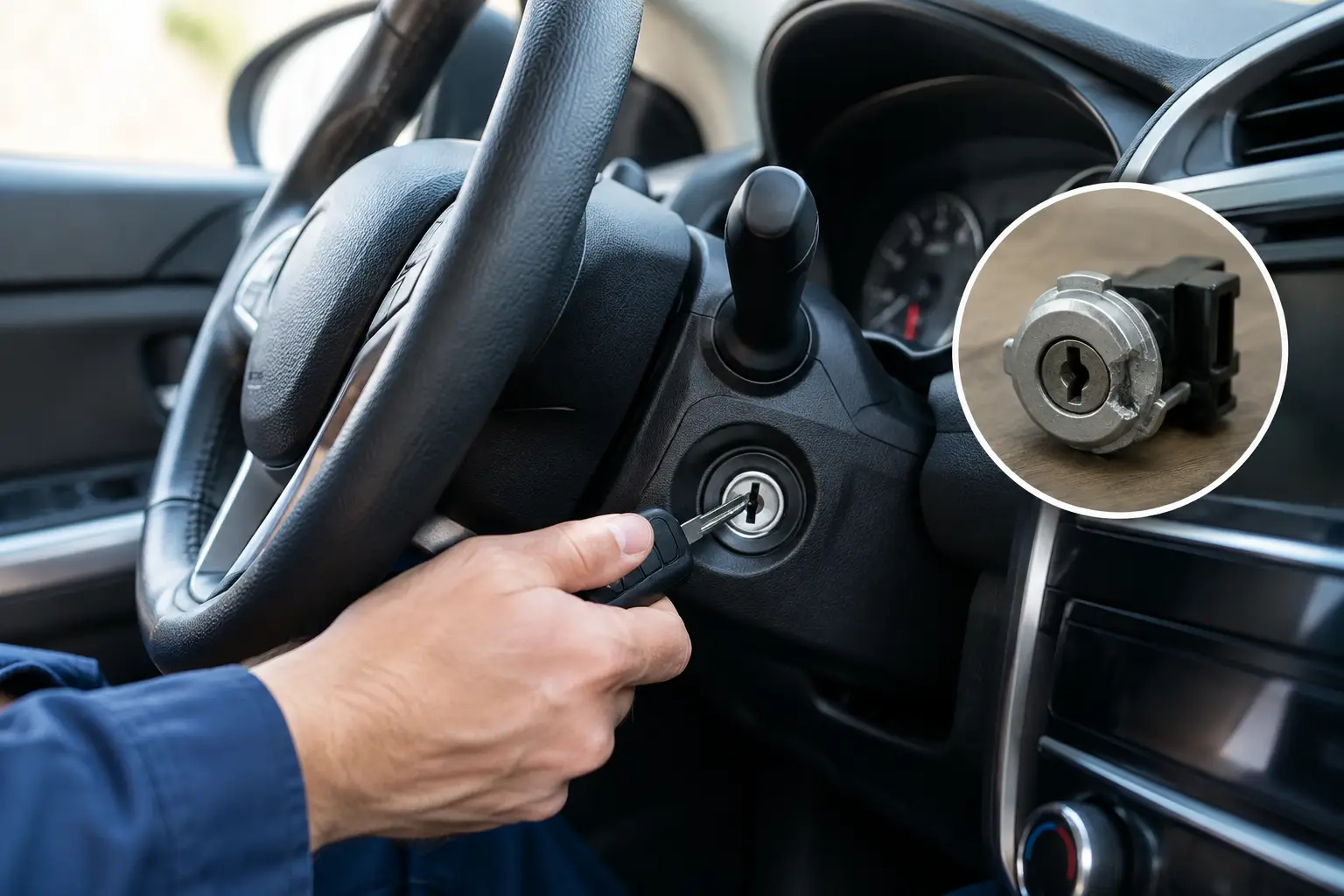
A steering lock warning can turn an ordinary school run, commute or work call-out into a car that will not move. You may be able to insert the key but not turn it, or see a message such as “Steering Lock Fault” while the engine refuses to start. Steering lock faults are frustrating because they often feel sudden, but the cause is usually somewhere in the key, ignition, steering column lock or vehicle electronics.
The right response is not to force anything. A key that is twisted too hard can snap in the ignition, and forcing the wheel can damage parts that may otherwise have been repaired. If your vehicle is safe where it is, take a moment to check the basics, then arrange specialist help if the lock will not release.
What does a steering lock do?
Most vehicles use a steering lock as an anti-theft measure. On older cars, it is a mechanical pin within the steering column. When the key is removed and the wheel is turned, the pin engages and prevents the wheel from rotating freely. Turning the correct key in the ignition releases it.
Many newer vehicles use an electronic steering lock. Rather than relying only on a physical ignition key, the vehicle communicates with the key, immobiliser and steering-column control unit. If that system does not recognise the key or cannot release the lock, the car may remain immobilised even if the key is physically present.
This is why the symptoms can vary. A vehicle with a worn mechanical ignition may have a key that will not turn at all. A car with an electronic lock issue may display dashboard warnings, accept a key or fob, yet still refuse to start.
Common signs of steering lock faults
The clearest sign is a steering wheel that remains locked when you try to start the vehicle. However, there are several earlier warning signs worth taking seriously. Catching them before the car is completely immobilised can save a great deal of disruption.
You may notice that the key only turns after several attempts, that you need to move the steering wheel to find the right position, or that the ignition feels stiff or catches. With keyless models, the dashboard may show an intermittent steering lock warning, a key not detected message, or a request to move the wheel while pressing the start button.
Other signs include a steering wheel that locks in an unusual position, a clicking noise from the steering column, an ignition that does not power up consistently, or a vehicle that starts one day and will not start the next. Do not assume an intermittent fault has fixed itself. It often returns at the least convenient time.
The key will not turn
A key that will not rotate can be caused by pressure on the steering lock, but it can also point to a worn key blade or an ignition barrel fault. If the steering wheel was turned after switching off, it may be pressing against the locking pin. This is common when parked with the wheels on full lock or against a kerb.
Try holding gentle pressure on the steering wheel in the direction it can still move while turning the key gently. Do not wrench the wheel or twist the key with force. If it does not release quickly, stop. Repeated attempts can wear the key further or break it inside the barrel.
A warning message appears but the car will not start
Electronic steering locks can fail because of an internal motor, lock mechanism, wiring issue, weak vehicle battery, control module fault or communication problem with the key. A low battery can create misleading warnings, especially in cold weather, but a battery charge alone will not cure every fault.
If you have a spare key, it is sensible to try it once. A damaged or poorly programmed key can be the problem. If both keys produce the same warning, the issue is more likely to be in the vehicle rather than the key itself.
Why steering lock faults happen
Mechanical parts wear. The cuts on a frequently used key can become rounded over time, particularly if it is used to open parcels, lever objects or carried loose with heavy keys. A worn blade may still open a door but fail to align the internal pins in the ignition barrel accurately enough to release the steering lock.
Ignition barrels also wear internally. Dirt, damaged wafers and years of turning pressure can make the mechanism increasingly unreliable. In some cases, a previous key repair or copied key that was not cut accurately has accelerated the issue.
With electronic systems, faults can develop in the steering lock module itself or in the connections and wiring that support it. Water ingress, low voltage, an ageing battery and component failure are all possible causes. Diagnosis matters because replacing the wrong part does not get you moving and can create further complications with the immobiliser system.
What to do when the steering lock will not release
Start by making sure the vehicle is secure and not creating a hazard. Put the handbrake on, select park or neutral as appropriate, and switch off any unnecessary electrical items. If you are at the roadside, keep yourself away from moving traffic and do not sit in an unsafe position while trying repeated starts.
For a traditional ignition key, use only light, controlled pressure. Hold the wheel towards the side with a little movement and turn the key gently. If you have a genuine spare key, try it once. Avoid spraying oil, household lubricants or WD-40 into the ignition. These products can attract dirt, affect electrical components and make later repair more difficult.
For a push-button start vehicle, check that the key fob battery is not obviously flat and that the main vehicle battery has not gone weak. Follow the vehicle handbook’s emergency key recognition procedure if it has one. If a steering lock fault message remains, do not keep cycling the ignition or repeatedly pressing the start button. A professional diagnostic check is the sensible next step.
When you need an auto locksmith
Call a specialist when the key will not turn, the key has snapped, the steering wheel remains locked, or the vehicle shows an electronic steering lock fault and will not start. These are not faults to solve by bypassing the lock or dismantling the steering column at the roadside.
A properly equipped auto locksmith can assess whether the issue is the key, ignition barrel, electronic steering lock or immobiliser communication. Depending on the vehicle and fault, the work may involve cutting and programming a replacement key, repairing the ignition lock barrel, extracting a broken key, or carrying out the required diagnostics and programming on site.
For drivers across the West Midlands and Warwickshire, Car Key Maker provides mobile assistance for key, ignition and vehicle access problems, so there is no need to assume a dealer visit is your only option. The key is to explain the symptoms clearly when you call: the vehicle make and model, whether the key turns, any dashboard message, and whether you have a spare key available.
Can a steering lock fault be prevented?
Not every failure is preventable, particularly with an electronic component nearing the end of its life. However, small warning signs should not be ignored. If the key is sticking, the ignition feels rough, or an electronic warning has appeared more than once, arrange an inspection before the vehicle is left stranded.
Keep your main key in good condition and avoid attaching a heavy bundle of keys to it. Use a damaged key only as a temporary measure, not for months. If you have only one working key, getting a spare made before a fault develops gives you a useful way to rule out a key problem and avoids being left with no access at all.
A locked steering wheel is not always a major failure, but it should never be treated with force. Gentle checks may release a simple pressure lock. If they do not, stop before a small fault becomes a broken key or damaged ignition, and get the right help to put your car back on the road safely.