
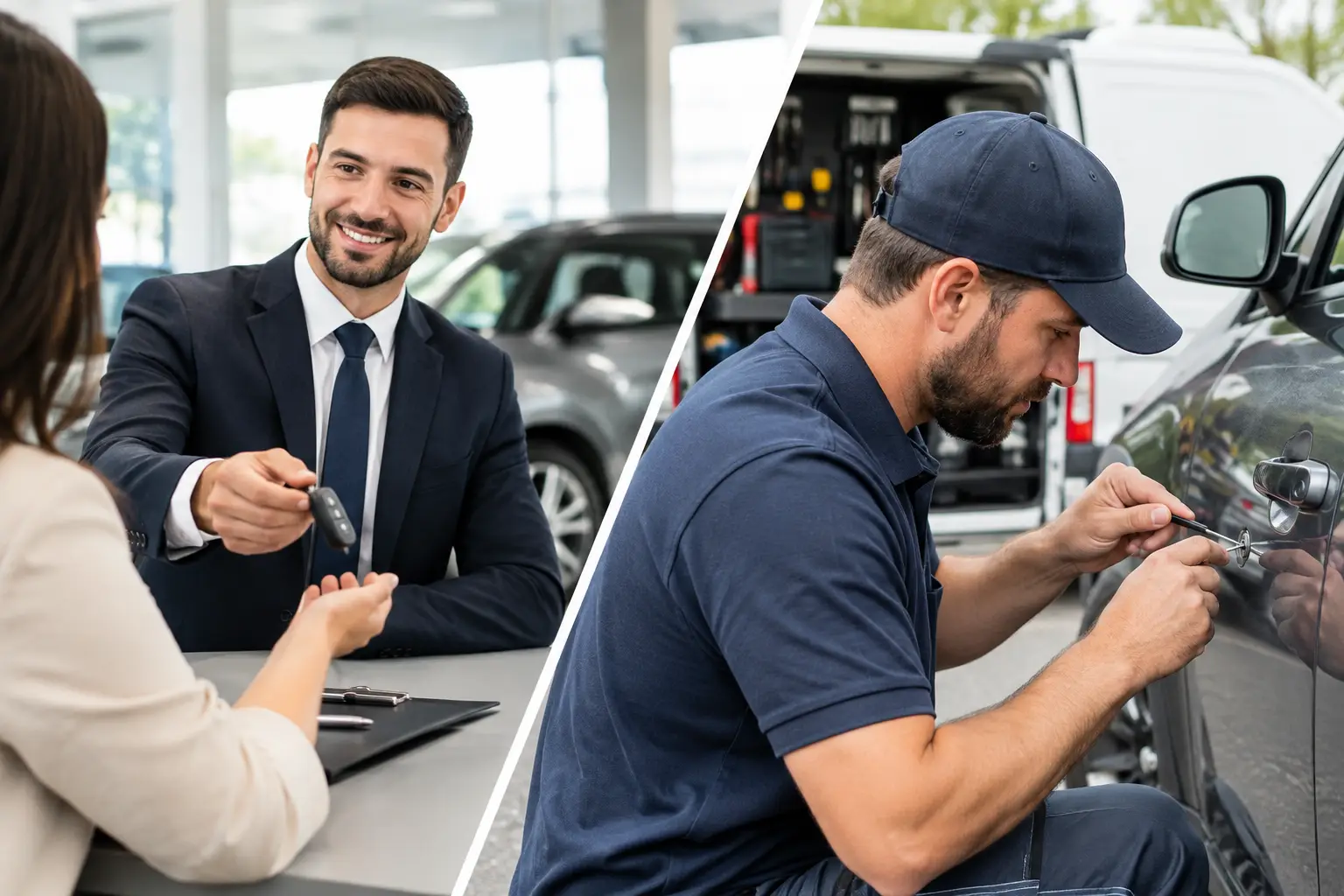
A key fails in a supermarket car park, the remote stops responding before work, or the only key has gone missing. At that point, the dealer versus mobile locksmith decision is not theoretical. You need to know who can get you moving again, where the work can be done, and whether your vehicle needs specialist key, lock or ignition attention.
For many everyday key emergencies, a mobile auto locksmith can attend the vehicle and complete the job on-site. A main dealer can still be the right route in some circumstances, particularly where manufacturer-only work or an active warranty issue is involved. The best choice depends on the fault, the vehicle and how urgently you need access.
Dealer versus mobile locksmith: the practical difference
The biggest difference is where the work happens. A dealer generally requires the vehicle to be brought to its premises. If the car will not start because every key is lost, the key has snapped, or the ignition will not turn, that may mean arranging recovery first.
A mobile auto locksmith comes to the vehicle. For a driver stranded at home, outside work, at the roadside or in a car park, this removes an extra step at a time when the situation is already stressful. A properly equipped locksmith can assess the vehicle in front of you, cut or programme a replacement key where appropriate, gain entry after a lockout, and investigate faults with the lock or ignition.
This is not simply about convenience. Modern vehicle keys are linked to the car’s immobiliser system. The work often requires the correct diagnostic equipment, key programming capability and an understanding of the security system fitted to that particular make and model.
When a mobile locksmith is usually the better fit
A mobile locksmith is often the most practical choice when the problem stops you using the vehicle now. Lost keys, damaged remotes, keys locked inside the car and ignition barrel faults are all issues that can leave you stuck where you are.
All keys lost or stolen
Losing the only working key is one of the clearest reasons to call a mobile specialist. The vehicle may be locked, immobilised and unable to be moved. The locksmith can attend, establish ownership, create a working key where possible and programme it to the vehicle.
If keys have been stolen, the job should go beyond making another key. The old key may need to be removed from the vehicle’s memory so it can no longer start the car. In some cases, changing locks or addressing the ignition is also sensible for peace of mind. This is security work, not just a replacement-key job.
Locked out with the keys inside
A lockout can look simple from the outside, but forcing a door, bending a frame or trying improvised tools can cause damage and make the repair more involved. A vehicle locksmith uses non-destructive entry methods wherever the vehicle and situation allow.
Once access is restored, they can also check why the lockout happened. A weak remote battery, a faulty central locking system, a worn key blade or an accidental auto-lock setting can all play a part. Finding the cause may help prevent a repeat call-out.
A key that is worn, broken or unreliable
Warning signs are easy to overlook. The key may need wiggling in the ignition, the remote may work only at close range, or the blade may show visible wear. Leaving it until it fails completely can turn a manageable problem into an immobilised vehicle.
A mobile locksmith can inspect the key and the lock, then advise whether a duplicate, remote repair, new programmed key or ignition repair is needed. That diagnosis matters. Replacing a key alone will not fix a worn ignition barrel, and repairing an ignition will not cure an immobiliser communication fault.
Ignition lock barrel problems
If the key will not turn, is stuck, or turns without starting the vehicle, the ignition lock barrel may be worn or damaged. Repeatedly forcing the key risks breaking it in the barrel and can make the situation worse.
This is a hands-on repair that is well suited to a specialist who can inspect the vehicle on-site. Depending on the fault, the ignition may be repaired or replaced, and the keys checked so the same wear pattern does not cause another failure soon afterwards.
When a dealer may be the right choice
A dealer is not automatically the slower or less suitable option. There are situations where it makes sense to use the manufacturer route.
If the vehicle has a complex manufacturer recall, a fault that requires a brand-specific software update, or work being handled under a manufacturer warranty, the dealer may be best placed to deal with it. Dealers also have access to factory technical bulletins and manufacturer parts systems that can be useful for unusual faults.
Some very new, specialist or high-security vehicles may have systems that limit what can be completed away from the dealer network. A reputable mobile locksmith will be straight with you if the vehicle needs dealer-level intervention rather than promising a fix that is not realistic.
The key point is that a dealer appointment is often designed around planned servicing and workshop work. It may not be the most practical answer when you are locked out on a wet evening or cannot start the vehicle before a school run.
What a qualified mobile locksmith can do on-site
A capable auto locksmith does more than open doors. Their work can include replacement car keys, spare key duplication, remote casing and button repairs, transponder programming, emergency vehicle entry, ignition barrel repairs and key deletion following a theft.
The right tools are only part of the job. Different makes use different key profiles, immobiliser systems and programming procedures. The locksmith needs to identify the actual fault before starting work, rather than treating every non-start as a flat remote battery or every lockout as a door-opening job.
For example, a car can fail to start even when the key blade turns correctly. The problem may be a transponder chip, an immobiliser issue, a damaged remote circuit or a fault elsewhere in the vehicle. Clear diagnosis helps avoid unnecessary work and gives you a sensible next step.
Questions to ask before you choose
Whether you contact a dealer or a locksmith, explain exactly what has happened. Say whether you have any working keys, whether the vehicle is locked, whether the key turns in the ignition and whether warning lights are showing. Details such as the make, model, year and registration can help establish what equipment and key type may be required.
Ask if the provider can deal with your specific vehicle and fault, whether the work can be completed at the vehicle, and what proof of ownership you will need. A professional should expect to verify that you are entitled to access or have keys made for the vehicle.
It is also worth asking what happens if the fault is not the key itself. A reliable specialist will explain the likely cause in plain language and tell you when another repairer or a dealer is the more appropriate next stop.
Avoid making the problem worse
When a key or lock fails, the temptation is to try whatever is to hand. Avoid forcing a stiff key, using glue on a snapped blade, repeatedly pressing a failing remote or attempting to prise open a door. These can damage components that might otherwise have been repaired.
Keep any broken key pieces, old remotes and remaining spare keys. Even a damaged key can provide useful information about the blade, chip or remote type. If keys have been stolen, tell the locksmith immediately so the security risk can be considered from the start.
For drivers across the West Midlands and Warwickshire, Car Key Maker provides on-site help for the key, lock and ignition problems that cannot wait for a workshop visit.
The right choice is the one that matches the fault, not the badge above the door. If your car is immobilised where it stands, start with a qualified mobile auto locksmith who can assess the problem properly and give you a clear route back on the road.