Replacement Car Key Turnaround Time Explained

Blog

Replacement Car Key Turnaround Time Explained

You usually find out how much replacement car key turnaround time matters when you’re already stuck – late for work, stranded in a parking lot, or staring at a car that will not start. In that moment, the real question is not just, “Can I get a new key?” It is, “How fast can this be sorted, and what is going to slow it down?”

The short answer is that some replacement keys can be done the same day, often within a couple of hours, while others take longer because the vehicle, the key type, or the security system adds extra steps. If you are dealing with a basic older key, turnaround is usually quicker. If you have a late-model smart key with push-button start, proximity functions, and encrypted programming, the job can take more time.

What affects replacement car key turnaround time?

There is no single timeline that fits every car. Replacement car key turnaround time depends on a few practical factors, and most delays come down to access, programming, and parts.

The biggest factor is the type of key your car uses. A simple metal key with no chip is usually the fastest to cut. A transponder key adds programming, which means the locksmith has to cut the blade and pair the chip to the vehicle. Remote keys and flip keys add another layer because the buttons and remote functions also need to be tested. Smart keys are usually the most time-consuming because they involve advanced programming and, in some cases, security procedures that vary by make and model.

Whether you still have a working key also matters. If you have one key left and just need a spare, the job is often faster. If all keys are lost, the locksmith may need to generate a key from the lock, decode the vehicle, or access immobilizer data before programming can even begin. That is more involved than copying a working key.

Vehicle make and model can speed things up or slow them down. Some brands are straightforward. Others use tighter security systems, limited programming methods, or components that are simply harder to source on short notice. Newer vehicles also tend to have more complex anti-theft systems, which is great for security but not always great for speed when you need a replacement key in a hurry.

Then there is the parts issue. Many mobile auto locksmiths carry a wide range of keys, remotes, and programmer tools in the van, which helps keep jobs same-day. But not every vehicle uses a commonly stocked key. If your car needs a specific smart fob, uncommon blade, or dealer-level part, turnaround may depend on getting the right item first.

How long does it usually take?

For a standard non-chip key, the actual cutting can be quick. In many cases, the job can be completed during a single visit with little delay once the locksmith is on site.

For a transponder key, expect a bit more time because the key has to be cut and programmed. That still often fits within a same-day callout, especially if the locksmith has the right equipment and the vehicle is accessible.

For a remote key or flip key, turnaround is often similar, but there is more testing involved. Lock, unlock, trunk release, panic button, and starting function all need to work properly before the job is done.

For smart keys, the time can vary more. Some are straightforward with the right tools. Others require additional steps that add time, especially if all keys are lost or the vehicle’s system is being cautious about accepting a new key.

That is why the most honest answer is this: replacement car key turnaround time can range from under an hour on simpler jobs to several hours or longer on complex ones. Same-day is common with a skilled mobile specialist, but not every key on every car is a quick in-and-out job.

Why dealerships often take longer

A lot of drivers assume the dealership will be the fastest option because it is the official route. In practice, that is often not the case.

Dealerships usually work on an appointment basis, and they may need you to arrange transport because the car cannot always be dealt with where it sits. If all keys are lost, that can mean towing the vehicle, waiting for a service slot, and then waiting again for key ordering and programming. Even if the actual key work is not especially complicated, the process around it can add days.

A mobile auto locksmith works differently. The point is speed and convenience. The locksmith comes to the vehicle, checks the situation on site, and handles the cutting and programming there when possible. That removes one of the biggest causes of delay – getting the car to somebody else.

There are exceptions. Some very new or highly restricted vehicles may still involve dealer-only parts or procedures. But for many everyday key replacement jobs, a capable mobile locksmith is faster simply because the service model is built for urgent callouts.

What can delay a same-day key replacement?

The first delay is missing information. If the locksmith does not know the exact make, model, year, and problem before arrival, it is harder to bring the right key and prepare the right programming method. “I lost my car key” is a start, but “2018 Ford Focus, all keys lost, push-button start” is far more useful.

The second issue is vehicle access. If the car is in an underground garage with poor signal, blocked in tightly, or suffering from a dead battery, the job may take longer. Programming often needs stable vehicle power, and physical access matters more than most people realize.

The third is security verification. A legitimate locksmith should confirm ownership before replacing keys. That protects you, but it can add a little time if documents are missing or the vehicle details do not line up.

The fourth is damage beyond the key itself. Sometimes the key is not the only problem. If the ignition barrel is worn, the remote is dead, the lock has been tampered with, or the immobilizer system is faulting, the appointment can turn into diagnosis plus repair. That is still fixable, but it is no longer just a simple replacement key job.

How to speed the process up

If you want the fastest possible result, give clear details when you call. The ideal information includes your vehicle make, model, year, whether you have any working key, whether the car uses push-button start, and where the vehicle is located.

It also helps to explain the actual failure. Lost key, broken blade, key stuck in ignition, remote stopped working, key turns but will not start the car – these are different problems, and they do not all have the same fix.

Keep your ID and proof of ownership ready. If the car battery is flat, mention that too. A good locksmith would rather know everything up front than arrive and discover three extra problems that could have been planned for.

If speed matters, be honest about urgency. Emergency jobs can often be prioritized, but only if the locksmith understands what is going on.

Is faster always better?

Usually, yes, but only if the work is done properly. A rushed job that leaves you with a poorly cut blade, unreliable programming, or a remote that works only some of the time is not a real solution.

Good turnaround means efficient work, not corner-cutting. The key should start the car consistently. Remote functions should be tested. If old keys need deleting from the system for security reasons, that should be handled too. This matters even more if a key has been stolen rather than simply misplaced.

That is where experience shows. A specialist who handles car keys every day can move quickly without guessing. They know which jobs are simple, which ones are likely to fight back, and when the issue is actually in the ignition, remote, or immobilizer rather than the key alone.

What to expect from a mobile locksmith visit

A proper mobile visit should feel straightforward. After confirming the vehicle details and ownership, the locksmith assesses the key type, the lock or ignition condition, and the programming route. If the right parts are on hand, the new key is cut and programmed on site, then tested before the job is signed off.

On a simple job, that process is quick. On a more involved one, you should still get clear communication about what is causing the delay and what the next step is. That matters when you are stressed and need a straight answer.

For drivers who need the car back on the road fast, that is really what replacement car key turnaround time comes down to – not just the key itself, but whether the person handling it has the tools, stock, and experience to solve the whole problem where the car sits.

When your key fails, the fastest job is usually the one diagnosed correctly the first time. A clear call, the right information, and a mobile specialist who knows the difference between a quick fix and a deeper fault can save you hours of waiting and a lot of avoidable hassle.
Mobile Locksmith vs Dealer Towing

Your car is stuck in a parking lot, your keys are missing, and the first decision matters more than most drivers realize: mobile locksmith vs dealer towing. Make the wrong call and you can lose half a day, pay for a tow you did not need, and still wait longer than expected to get back on the road.

For most key and lock problems, a mobile auto locksmith is the faster and more practical option. But not every situation is the same. Some vehicles, some security issues, and some warranty cases can still push you toward a dealer. The smart move is knowing which service actually fits the problem in front of you.

Mobile locksmith vs dealer towing: what is the real difference?

A mobile auto locksmith comes to your vehicle and handles the work on-site. That usually includes car key replacement, key duplication, lockout service, remote issues, ignition barrel repair, and in many cases programming a replacement key to the vehicle.

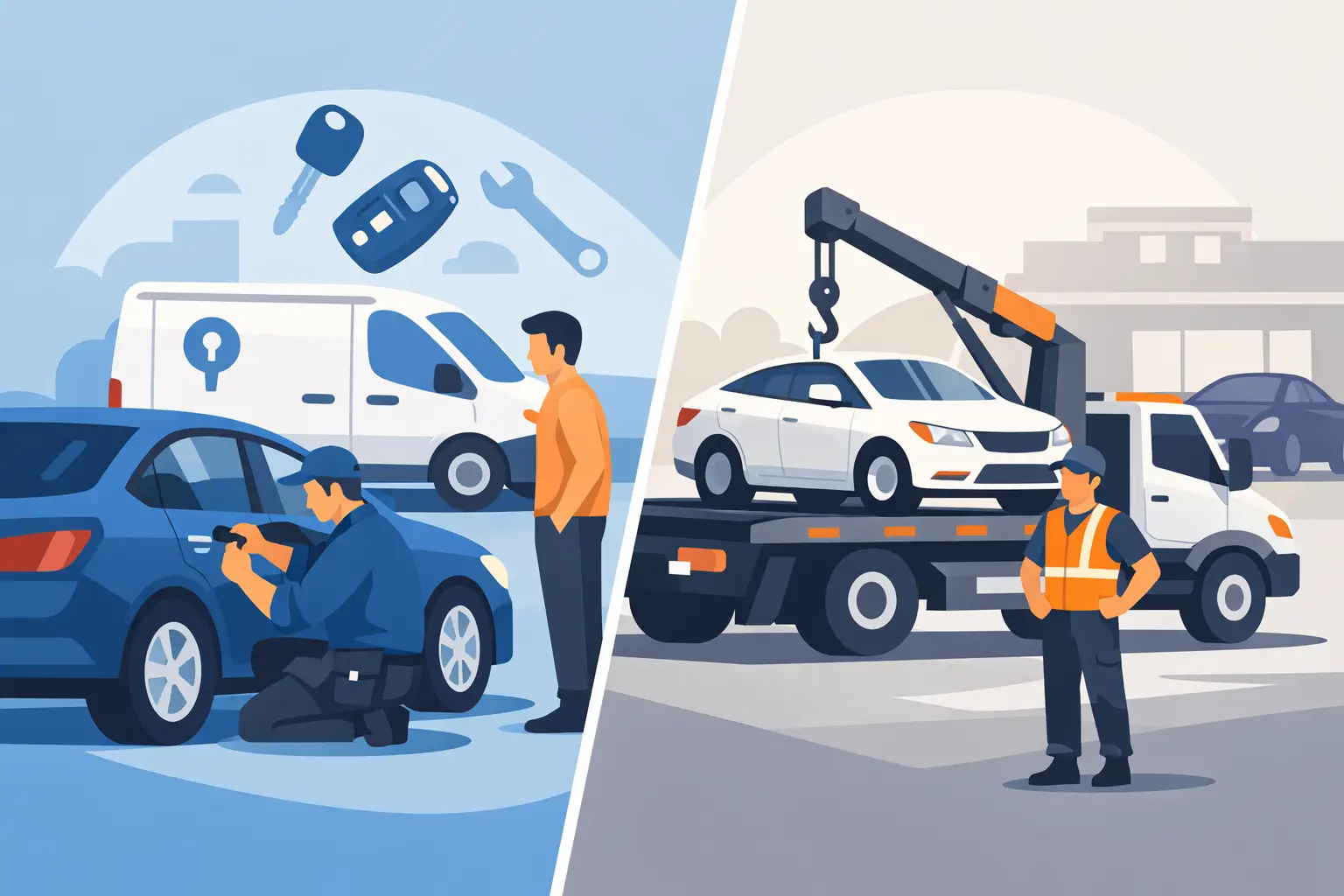
Dealer towing works differently. If your car cannot be driven because the key is lost, broken, or not recognized, the vehicle often has to be towed to the dealership first. Only then does the diagnostic and key ordering process begin. That extra step changes the cost, the timing, and the amount of hassle involved.

This is why the comparison is not just locksmith versus dealer. It is usually locksmith on-site versus dealer plus tow truck plus scheduling delay.

When a mobile locksmith usually makes more sense

If all keys are lost, you are locked out, the key snapped in the lock or ignition, the remote stopped working, or the ignition barrel is worn, a mobile locksmith is often the most direct fix. These are field-service problems by nature. The vehicle is already where it is, and the technician brings the tools, blanks, programming equipment, and repair knowledge to you.

That matters when you are at home before work, outside a grocery store with kids in the car park, or standing beside a work van that cannot move. Most people do not care where the fix happens. They care how quickly they can leave.

A good mobile locksmith also cuts out the wasted step of recovery. If the vehicle can be repaired and keyed where it sits, towing becomes an avoidable expense rather than part of the solution.

In urgent situations, this is usually the biggest advantage. Same-day response is not a luxury when your car is your commute, your school run, or part of your business.

Cost is not just the invoice

Drivers often assume a dealer is the official option and therefore the safest one. That may be true in a narrow sense for some manufacturer-specific cases, but it does not mean it is the most cost-effective route.

With dealer towing, the real bill often comes from several moving parts. There is the towing charge, the dealership labor rate, possible diagnostic fees, and in some cases a delay while a key is ordered. If the vehicle is off the road for days, there is also the hidden cost of missed work, rearranged plans, rental cars, or relying on someone else for transportation.

A mobile locksmith typically removes at least one major cost immediately: towing. In many common situations, that changes the whole math. Even if the key itself is not cheap, avoiding transport, extra scheduling, and multiple appointments often makes the overall solution far more realistic.

That is especially true with older cars, everyday family vehicles, and work vans where the owner needs a practical fix, not a long process.

Speed matters more than people expect

Most key emergencies are not dramatic until they start eating time. What feels like a simple lost-key problem at 8 a.m. can become a missed shift, a canceled appointment, or a stranded customer by noon.

A mobile locksmith is built for that reality. The job starts where the vehicle is. There is no waiting for a tow slot, no separate handoff to a service department, and no need to arrange transport just to begin diagnosis.

Dealers are not designed around roadside urgency. They are designed around workshop scheduling. That does not make them bad. It just means their process often moves at a different pace than the customer needs in an emergency.

If your priority is getting the car moving again as fast as possible, on-site service usually has the edge.

Mobile locksmith vs dealer towing for lost all keys

This is one of the clearest examples. If you have lost all keys, the vehicle is effectively immobilized. A dealer may be able to supply a replacement, but the car often has to reach them first. That can turn one problem into two.

A qualified mobile auto locksmith can often generate, cut, and program a replacement key at the vehicle. On many makes and models, that means the problem is solved without ever moving the car.

There is another advantage here that drivers overlook: security. If keys were stolen rather than simply misplaced, a locksmith may be able to delete old keys from the system and, where needed, change locks. That is a practical response when you are worried someone else may still have access to the vehicle.

A dealership may also handle parts of this, but the mobile option is often more immediate and more suited to the urgency of the situation.

When the dealer may still be the better call

There are cases where a dealer is the right move. If the issue goes beyond keys and locks and points to a deeper manufacturer-specific electronic fault, a dealership may have model-specific systems and factory procedures that make sense. The same applies if the vehicle is under a warranty plan that requires dealer involvement.

Some very new or high-security vehicles can also be more restrictive. Certain brands use tighter programming controls, and access to replacement credentials may be more limited. In those situations, an experienced mobile locksmith will usually tell you plainly if dealer involvement is necessary.

That honesty matters. The best service is not about forcing every job into one solution. It is about getting you to the right fix without wasting your time or money first.

The convenience gap is bigger than it sounds

People hear the word convenience and think it means a minor perk. In vehicle key emergencies, convenience is often the whole point.

If you are at home, a mobile locksmith can work on the drive. If you are at work, the repair can often happen in the parking lot. If the car is stuck at a shopping center, on a side street, or outside a school, the technician comes to that location. That saves time, but it also reduces stress because you are not trying to organize a recovery, a ride, and a service appointment at the same time.

For parents, commuters, and tradespeople, that difference is hard to overstate. The less your day gets rearranged around the problem, the better the service has done its job.

What to ask before you choose

Before agreeing to a tow or booking a service, ask a few direct questions. Can the issue be handled on-site? Can a replacement key be cut and programmed where the car is? If the ignition is the problem, can it be repaired rather than replaced? If keys were stolen, can old keys be erased from the system?

The answers will tell you quickly whether you need transport to a dealer or whether you are looking at a mobile job. A reliable locksmith should also be clear about timing, coverage, and price before the work starts.

That clarity matters when you are already stressed. You do not need vague promises. You need to know who can solve the problem today.

The practical answer for most drivers

In a straight mobile locksmith vs dealer towing comparison, the mobile locksmith usually wins on speed, convenience, and total cost for common car key and lock issues. That is especially true when the vehicle is stranded only because of the key, remote, lock, or ignition barrel.

The dealer still has a place, particularly for certain new vehicles, warranty claims, or manufacturer-level electronic faults. But for everyday emergencies, towing the car somewhere else is often the long way around a problem that can be fixed where the vehicle already sits.

If your car will not start because the key is lost, broken, locked inside, or no longer working properly, the best next step is usually the most direct one: get someone to come to the vehicle and solve it there. When the right help arrives fast, the whole situation gets smaller.

Car Key Blade Snapped? What to Do Next

You go to unlock the car or turn the ignition, feel a sudden give, and then realize the car key blade snapped. It usually happens at the worst possible moment – before work, on the school run, or when you’re already late. The good news is that a broken key does not always mean a major repair, but the next few minutes matter if you want to avoid making the problem worse.

When a car key blade snapped, what actually broke?

The blade is the metal part of the key that goes into the door lock or ignition. On many modern car keys, that blade folds into the remote fob or is attached to a plastic head containing the chip that communicates with the immobilizer. If the blade snaps, you may still have the electronic part of the key, but that does not mean the car will start or the doors will open.

A clean break in the blade is very different from a problem inside the fob, a dead battery, or a worn ignition barrel. Sometimes the key breaks because the metal has weakened over time. Sometimes the real issue is resistance in the lock or ignition, and the blade simply becomes the part that gives way first. That difference matters because replacing just the blade may solve it, or it may only be half the job.

What to do first if the car key blade snapped

Start by checking where the broken piece is. If the snapped section is still in your hand and nothing is stuck in the door or ignition, the situation is usually simpler. If part of the key is stuck inside the lock or ignition, stop trying to force it out with random tools.

Tweezers, paper clips, and screwdrivers often turn a manageable problem into a more expensive one. They can push the fragment deeper, damage the wafers inside the lock, or scratch the ignition barrel. If the lock has already become stiff, forcing it can make extraction and repair more complicated.

If you have a spare key, do not rush to use it in a stiff ignition or sticky door lock until the underlying cause is clear. A second key can snap too, especially if the lock is binding. A fast check by an auto locksmith is often cheaper than risking a second failure.

If you are stranded somewhere unsafe, your first priority is your location, not the key. Move yourself and any passengers to a safe place if possible and get help on the way.

Can you still drive if the car key blade snapped?

It depends on the type of key and where it broke.

If the blade snapped but the immobilizer chip is intact inside the fob, some vehicles may still recognize the key if the chip is held close enough to the ignition area or start button. That said, recognition alone will not help if you cannot physically turn the ignition or access the vehicle. On older cars with a traditional key, a broken blade often means you cannot drive at all until the key is repaired or replaced.

With flip keys, there is another wrinkle. If the blade has become loose at the hinge before snapping completely, the remote may still lock and unlock the car, but the key may fail when you need to turn the ignition. That catches a lot of drivers out because the remote seems fine right up until the mechanical part lets go.

Why car key blades snap in the first place

Most snapped key blades are not random. They usually fail after wear has been building for a while.

One common cause is a worn key. Over time, the blade becomes thinner, rounded off, or stressed from daily use. Another is pressure on the key while it is in the ignition, such as a heavy keyring swinging while you drive. That extra weight puts strain on both the blade and the ignition.

Locks also play a role. If the door lock or ignition barrel is dry, dirty, worn, or slightly damaged, you may have been using more force than normal without thinking about it. In that case, replacing the blade alone may get you moving again, but the same issue can come back unless the lock itself is inspected.

There are also cases where the key was cut badly in the past. A poor copy can work just enough to seem usable, while quietly putting extra stress on the metal every time you turn it.

Repair or replace?

This is where a lot of people lose time. They tape the key together, try glue, or order a cheap shell online hoping for a quick fix. Sometimes that works for a very basic key with no chip issues, but more often it wastes money and delays the proper repair.

If the break is limited to the metal blade and the remote casing, chip, and electronics are still sound, a locksmith may be able to cut and fit a new blade to the existing fob. That can be the fastest and most cost-effective option.

If the fob is also cracked, the buttons are failing, or the transponder chip has been damaged or lost, a full replacement key is usually the smarter choice. The same goes for keys that have already been repaired badly before. A temporary fix on a weak key rarely stays temporary for long.

If part of the key is stuck in the ignition and the ignition has been damaged by forcing it, you may need both extraction and ignition repair. That is why the right diagnosis matters before anyone starts swapping parts.

What a mobile auto locksmith can do on-site

This is usually the point where mobile service makes the biggest difference. Instead of arranging towing or waiting days for a dealer appointment, an experienced auto locksmith can come to the vehicle, assess the lock, extract broken pieces safely, and cut or program the correct key on-site.

That matters because a snapped blade is not always just a key problem. It can be a lock problem, an ignition problem, or both. A proper on-site visit means the person fixing it can test the door, ignition, remote, and chip together rather than guessing from a parts counter.

In many cases, the job can be completed the same day. That includes cutting a new key blade, transferring or replacing the transponder, repairing a damaged remote shell, removing a broken fragment from the ignition, and checking whether the barrel itself is causing excess resistance.

For drivers in a hurry, the practical benefit is simple: you get a working key and a clear answer without moving the car first.

When a snapped key points to a bigger issue

Not every broken blade is a one-off. If your key was getting harder to turn, sticking in the ignition, or only working after a few attempts, the break may be a warning sign that the ignition barrel or door lock is worn.

Ignoring that can lead to repeat failures. You get a new blade cut, it works briefly, then the same stiffness returns. In the worst case, another key snaps or the ignition seizes completely. A good locksmith will tell you when the key is the only problem and when the lock needs attention too.

This is especially relevant for work vans, older family cars, and vehicles that see constant daily use. More usage means more wear. If the key has been showing signs of strain for weeks, treat the snapped blade as a symptom, not just the fault itself.

How to reduce the chances of it happening again

Keep your keyring light. It sounds minor, but constant weight on the key can shorten the life of both the blade and ignition. If the key starts feeling rough, do not keep forcing it for another month hoping it sorts itself out.

Get worn keys checked before they fail. A fresh copy taken from a good original can save a lot of trouble, but copying a badly worn key just duplicates the problem. If your remote shell is loose or cracked, have it repaired before the blade starts wobbling at the hinge.

Most of all, pay attention to resistance. A key should not need extra muscle. If it does, the cheapest fix is often the one done early.

A broken car key can feel like your whole day just fell apart, but it is usually solvable faster than people expect. The trick is not forcing it, not guessing, and getting the right help before a snapped blade turns into a damaged lock or ignition. If you’re stuck and the car key blade snapped, a proper mobile auto locksmith service can usually get you moving again without the extra cost and delay of the dealership route.

How to Fix Faulty Key Fob Problems Fast

Your key fob worked yesterday, and now it barely locks the car, only opens one door, or does absolutely nothing when you’re already late. That is usually when people start searching for how to fix faulty key fob issues fast – and the right fix depends on whether the problem is the battery, the buttons, the programming, or the car itself.

The good news is that many key fob faults are simple. The bad news is that guessing can waste time, especially if the car has push-button start, an immobilizer issue, or water damage inside the remote. If you want the quickest route back into your car and back on the road, start with the easy checks first, then rule out the more serious faults.

How to fix faulty key fob without wasting time

A faulty key fob does not always mean you need a full replacement. In a lot of cases, the remote still has life left in it. The trick is spotting the signs early.

If the range has suddenly dropped and you need to stand right next to the vehicle, the battery is the most likely cause. If one button works but another does not, the issue may be wear under the rubber button pad or damage to the circuit board. If the fob seems completely dead after being dropped in water, that is a different repair path altogether.

Start by checking whether the mechanical key still works. Many modern remotes have a hidden emergency key blade inside. If that blade opens the door, the car lock is not the problem. That points you back toward the fob battery, the remote electronics, or the programming.

Next, try your spare key if you have one. This is one of the fastest ways to narrow the fault down. If the spare works normally, the original fob is the issue. If neither fob works properly, there may be a vehicle-side fault, such as a weak car battery, receiver problem, or a system programming issue.

The most common key fob faults

Dead batteries are still the number one cause. Key fob batteries fade gradually, so the warning signs are easy to miss. You may notice delayed locking, inconsistent response, or reduced range for a few days before the fob stops working completely.

Worn buttons are also common, especially on older remotes that get used several times a day. The outer button can look fine while the tiny switch beneath it has broken loose or stopped making contact.

Water damage is more serious. Rain usually is not the issue. A fob dropped in a puddle, put through the wash, or left in a soaked jacket pocket can corrode quickly inside. Sometimes it fails immediately. Other times it keeps working for a day or two and then dies once the corrosion spreads.

There is also the possibility of lost programming. This can happen after battery changes, electrical faults, jump-starts, or internal remote failure. Some vehicles are forgiving. Others need proper diagnostic equipment to pair the key back to the car.

Change the battery first

If you are trying to figure out how to fix faulty key fob problems at home, this is the first job worth doing. It is quick, cheap, and often solves the issue.

Open the fob carefully using the release tab or the seam in the casing. Do not force it with a kitchen knife if the housing feels tight, because it is easy to crack the shell or damage the board inside. Once open, remove the old battery and check the battery code, usually something like CR2032 or CR2025.

Fit the new battery in the same direction as the old one. That matters more than people think. If it is upside down, the fob will still appear dead. Before snapping the case back together, check for dirt, green corrosion, or bent battery contacts.

After replacing the battery, test all buttons near the car. If the fob works normally again, the job is done. If it improves only slightly or still works intermittently, the problem may be with the button contacts or the internal board.

If the buttons feel loose or only work sometimes

A key fob that locks the car only after several presses usually has a worn internal switch or damaged contact points. Sometimes the outer rubber button has split, so the press no longer reaches the tiny switch underneath properly.

You can inspect the casing for wear and look for obvious damage, but internal board repairs are not always DIY-friendly. Some remotes can be cleaned and rebuilt. Others are sealed, brittle, or too badly worn to make repair worthwhile.

This is where the trade-off matters. A cheap casing replacement can make sense if the board is still healthy. But if the circuit board is damaged, spending money on a shell alone will not solve the problem. A proper locksmith can test whether the remote is transmitting at all before you pay for the wrong fix.

What to do after water damage

If the fob has gotten wet, remove the battery immediately. Do not keep pressing the buttons to “see if it still works” because that can make the damage worse.

Drying the outside is not enough. Moisture inside the fob can start corroding the board and battery terminals very quickly. In mild cases, careful disassembly and cleaning can save it. In worse cases, the remote may need repair or replacement, and if the chip inside has failed, the car may not recognize the key at all.

Rice is not a serious fix. It might absorb some surface moisture, but it does not clean corrosion from the board. If the key is valuable, especially a smart key or proximity fob, getting it inspected quickly gives you a better chance of saving it.

When the fob is not the only problem

Sometimes the remote is blamed when the real issue is the vehicle. If the car battery is weak, the locking system may behave unpredictably. If the car has receiver faults or immobilizer issues, a healthy key fob can still fail to communicate properly.

A common example is when the remote buttons stop working but the car still starts if you hold the fob close to the start button or steering column. That can point to low fob battery power or a signal issue rather than a fully dead key.

On some vehicles, repeated failed starts, warning lights, or a “key not detected” message suggest a programming or transponder fault. At that point, random battery changes and button pressing will not fix it. The key and vehicle need proper diagnosis.

How to fix faulty key fob programming issues

Programming problems are where many DIY attempts go wrong. Online instructions can be hit or miss because the process varies by make, model, and year. What works on one car may do nothing on another.

Some older vehicles allow simple onboard syncing steps. Newer vehicles usually require specialist tools to program the remote and transponder securely. If the key has lost sync after a battery change, you may be able to restore it with a manual procedure. But if the immobilizer data is corrupted or the remote board has failed, no amount of re-syncing will help.

If you have one working key and one faulty one, the repair is often easier. If all keys have failed or been lost, it becomes more urgent because the car may be fully immobilized. In those cases, a mobile auto locksmith is usually faster and more practical than waiting on a dealership appointment.

When to stop troubleshooting and call a locksmith

If you have changed the battery, checked the spare, and ruled out obvious casing damage, but the key still does not work properly, it is time to stop guessing. That is especially true if you are locked out, the car will not start, or the only working key is becoming unreliable.

A proper automotive locksmith can test the remote signal, inspect the board, confirm whether the transponder is reading correctly, and program or replace the key on-site if needed. That saves a lot of wasted money on batteries, online shells, and generic remotes that may never match your vehicle.

For drivers dealing with this in the West Midlands or Warwickshire, a mobile specialist like Car Key Maker can often sort the issue the same day without the hassle of towing the vehicle anywhere. That matters when the car is stuck at home, at work, or in a parking lot and you need a real fix, not a guess.

A faulty key fob is annoying when it starts and a full-day problem when it gets ignored. If the remote is showing early signs of failure, deal with it before it leaves you locked out or stranded somewhere inconvenient.

Broken Car Key Blade Repair Explained

A car key blade usually breaks at the worst possible moment – halfway into the ignition, bent in the door lock, or snapped off after weeks of feeling loose and worn. If you are dealing with that right now, broken car key blade repair may be possible, but the right fix depends on where it broke, how badly it is damaged, and whether the key still has a working chip or remote.

For most drivers, the real problem is not the metal itself. It is the fact that one damaged blade can leave you locked out, unable to start the car, or stuck using a key that could fail completely on the next turn. That is why it helps to know what can be repaired on the spot, what should be replaced, and when trying a quick DIY fix usually makes the situation worse.

What broken car key blade repair actually means

The blade is the cut metal part of the key that goes into the lock or ignition. On many modern car keys, that blade is attached to a plastic head, flip-key housing, or smart key emergency insert. When people ask for broken car key blade repair, they might mean a blade that has snapped in two, a blade that has come loose from the remote case, or a badly worn key that no longer turns smoothly.

A proper repair is not just gluing metal back together and hoping it holds. In real automotive locksmith work, repair usually means recovering the broken section if needed, checking the lock and ignition for damage, then either recutting a new blade, reattaching a serviceable blade into a new shell, or replacing the full key if the damage goes beyond the metal.

That distinction matters. Some keys can be saved quickly and cost-effectively. Others need a fresh blade and reprogramming. A good locksmith will tell you which is which instead of forcing a repair that will not last.

The most common ways a key blade breaks

Most broken blades do not happen because of one dramatic event. They usually fail after wear builds up over time.

A key that feels stiff in the ignition, needs wiggling in the door, or has visible thinning near the base is already warning you. Flip keys are especially prone to trouble because the blade pivots from the remote housing and takes extra stress every time it is folded in and out. If the hinge loosens, the blade starts taking force at the wrong angle.

Another common issue is using the key like a tool. People use it to open packages, pry trim, scrape ice, or twist a lock that is already jammed. That weakens the blade fast. If the ignition barrel or door lock is also worn, even a decent key can snap because it is working against internal resistance every time you turn it.

Sometimes the blade is not fully broken but bent, cracked at the shoulder, or wobbling inside the fob. That is still a failure in progress. Leaving it alone rarely helps.

Can a broken key blade be repaired, or do you need a new one?

It depends on the damage.

If the blade has simply come loose from the remote shell and the metal itself is still in good condition, a locksmith may be able to transfer it into a new case. If the blade is worn but not snapped, cutting a fresh blade from the existing key data or decoding the lock is often the better fix. If the blade has broken cleanly and the transponder chip is still fine, it may be possible to build a replacement key around that chip and save some cost.

If the blade snapped inside the ignition or door lock, the broken piece needs to be extracted first without damaging the lock. After that, the replacement route depends on whether the original key is still usable for copying and whether the lock has suffered damage from the break.

What usually does not make sense is trying to repair a severely cracked blade with adhesive or home soldering. Even if it holds for a moment, the key is still taking torque every time you use it. A weak repair tends to fail again when you are far from home, in bad weather, or in a hurry.

When repair is the smart option

Repair makes sense when the rest of the key is still healthy.

If your remote buttons work, the transponder chip is recognized by the vehicle, and the blade problem is limited to the metal section or housing, you may not need a full key replacement. That can keep cost down and get the car back on the road quickly.

This is especially useful with flip keys where the blade is loose, the case is cracked, or the hinge has failed. In those cases, the electronics can often be moved into a new shell and paired with a newly cut blade if needed. The result feels like a new key without replacing every component.

For older vehicles with simple mechanical or transponder keys, blade repair or replacement is often straightforward. For newer vehicles, it becomes more vehicle-specific because some keys combine blade, chip, battery housing, and remote components in ways that limit what can be reused.

When replacement is the better call

Sometimes repair is false economy.

If the blade has worn down so much that it is damaging the lock, if the remote casing is broken and the electronics are unreliable, or if the key has already been repaired before, a complete replacement is often the safer route. The same goes for keys that have been bent badly. Metal fatigue stays in the blade even if you straighten it.

If you only have one working key left and that blade is showing signs of failure, making a new key before it breaks is often the cheapest move. Waiting until it snaps can turn a manageable job into an all-keys-lost situation, which is slower and more expensive.

Why mobile help matters with a broken blade

When a key blade breaks, the vehicle often cannot be moved. That changes what practical help looks like.

A mobile auto locksmith can come to the car, extract broken pieces from the ignition or door lock, inspect the lock itself, cut a replacement blade, and deal with transponder or remote issues on-site. That removes the need to tow the vehicle or wait days for a dealer appointment.

For drivers using their car for work, school runs, or daily commuting, that speed matters more than anything else. A fast, correct repair saves time, avoids extra transport costs, and reduces the risk of further damage from forcing the lock.

This is where experienced service makes a difference. A proper diagnosis at the vehicle is often the only way to tell whether the problem is just the blade or whether the ignition barrel, door lock, or key housing also needs attention.

What to do right after the blade breaks

First, stop trying to turn the lock. Forcing it can jam the broken section deeper or damage the wafers inside the lock.

If part of the blade is sticking out, do not grab it with pliers unless it is loose and easy to remove. Twisting or pulling at the wrong angle often makes extraction harder. Keep every piece of the broken key, including the remote head and any loose chip or casing parts. Those parts may still help with cutting, coding, or rebuilding the key.

If you have a spare key, use it carefully. If the spare also feels stiff, the issue may be in the lock rather than the key. That is worth checking before you end up with two broken blades instead of one.

How to reduce the chance of it happening again

Most key blade failures give warning signs first. If the key is sticking, wobbling, or looking thin near the base, get it checked before it snaps.

Avoid heavy keychains pulling on the ignition key while driving. Do not use the car key for anything except the car. If your flip key feels loose at the hinge or the blade has side-to-side movement, replace the shell before the metal starts taking extra strain.

And if the ignition or door lock has become stiff, do not ignore it. Recutting a worn key or repairing the lock early is much easier than dealing with a snapped blade and a stranded vehicle later.

A broken key blade feels like a small part failure, but it can stop your whole day cold. The good news is that many cases can be fixed quickly when the problem is handled properly and early. If the key is already giving you trouble, treat that as your warning and get it sorted before the next turn is the one that leaves you stuck.

Car Door Wont Unlock? What to Check First

You walk up to the car, press the remote, pull the handle, and nothing happens. If your car door wont unlock, the problem can be as simple as a dead key fob battery or as frustrating as a failed door lock actuator. Either way, the main thing is to avoid making it worse by forcing the handle, twisting the key too hard, or prying at the door.

Some lock problems are quick fixes. Others point to a fault inside the door, the key, or the vehicle’s security system. The right next step depends on one detail – is the issue affecting one door, all doors, or only certain ways of opening the car?

When a car door wont unlock, start with the pattern

Before you try anything else, take ten seconds to notice what is and is not working. That saves time and can stop a small issue from turning into a broken lock, snapped key, or damaged trim.

If none of the doors respond to the remote, the problem is often with the key fob battery, the vehicle battery, or the central locking system. If one door will not open but the others do, that usually points to a mechanical fault in that specific door. If the key turns but nothing happens, the lock mechanism may be worn or disconnected. If the key does not turn at all, the lock cylinder may be jammed, frozen, or damaged.

That distinction matters because the fix for a weak remote is very different from the fix for a failed actuator buried inside the door.

The most common reasons your car door wont unlock

A dead or weak key fob battery is one of the most common causes. People often assume the car has a major lock fault when the remote simply is not sending a strong enough signal. Sometimes you will notice reduced range first. Other times it stops working all at once.

A flat vehicle battery can cause the same confusion. If the car has no power, central locking may not respond at all. On some vehicles, the mechanical key should still open the door, but not always if that lock has not been used in years and has seized up.

A worn key is another frequent problem. Over time, the cuts on the blade wear down. The key may still start the ignition on some older vehicles or work occasionally in one lock but not another. That inconsistency is usually a warning sign, not bad luck.

Then there is the lock itself. Dirt, corrosion, internal wear, and failed components inside the latch can stop the door from opening. Modern vehicles also rely on actuators, wiring, and control modules. When one of those fails, the door may stay locked even though the rest of the car responds normally.

In colder weather, ice can be the issue. In hotter weather, swollen seals or sticky internal parts can add resistance. And after accident damage, even minor damage, door alignment can affect how the latch and lock behave.

What you can safely try first

Start with the simple checks. If you have a spare remote, test it. If the spare works, your main key fob is the likely problem. If neither remote works, try the mechanical key if your vehicle has one.

If the mechanical key will not go in smoothly, do not force it. That can bend the key or damage the lock cylinder. If it goes in but feels stiff, a lock may be seized or dirty. Gentle pressure is one thing. Leaning your body weight into it is another.

If one door will not open, try another door or the trunk. On some vehicles, you can gain access through a different opening and work the affected door from inside. If the inside handle also fails, that points more strongly to an internal latch or lock fault rather than a remote issue.

Check the car battery if the whole vehicle seems dead. No interior lights, no response from the fob, and no dashboard activity all suggest a power issue. In that case, the door lock problem may be a symptom rather than the root cause.

If the weather is freezing and the key or lock feels icy, avoid pouring hot water on the door. That can create more problems fast. A frozen lock needs a careful approach, not a quick gamble.

What not to do

This is where many lockouts get more expensive.

Do not wedge screwdrivers or metal tools into the door frame. It is very easy to bend the frame, tear the weather seal, scratch paint, or damage side curtain airbag areas. Do not yank the outside handle repeatedly if it feels loose or stuck. If a linkage clip inside the door has already failed, more force will not fix it.

Do not keep twisting a key that is struggling to turn. Worn or weak keys can snap, and once the blade breaks in the lock, the job gets more complicated. The same goes for folding keys with damaged hinges. If the key feels unstable, stop.

DIY sprays can also be hit or miss. A proper lock lubricant may help in some cases, but the wrong product can attract dirt or gum up the cylinder over time. If the lock is already damaged inside, spray alone will not sort it.

Signs you need a locksmith instead of trial and error

If the key is stuck, the key will not turn, the remote is not responding, and you cannot access the vehicle through another door, it is usually time to get professional help. The same applies if you have children, pets, medication, or essential work tools inside the car. At that point, speed matters more than guesswork.

A mobile auto locksmith can usually tell very quickly whether the issue is the key, the lock, the latch, the central locking system, or the vehicle battery. That matters because a lot of drivers assume they need a replacement key when the real problem is inside the door. Others assume the door is broken when the fob has simply failed.

If all keys are lost, stolen, or locked inside, a specialist can also handle more than just entry. Depending on the vehicle and fault, they may be able to cut and program keys, repair damaged remotes, deal with broken key blades, and diagnose ignition or immobilizer-related issues on-site.

Why one locked door can be harder than a full lockout

It sounds backward, but a single jammed door can sometimes be more awkward than a car that is completely locked. If the affected door has a failed latch or actuator and it will not respond from either handle, getting it open without damaging trim or hardware takes experience.

That is especially true on newer vehicles where access is tighter and electronic components are more sensitive. There is no universal trick that works on every make and model. What works on an older sedan may be the wrong move on a newer SUV with deadlocks or extra security features.

This is also where cheap fixes can waste time. Replacing a key fob battery will not repair a broken actuator. Smacking the door might make a failing part move once, but it is not a real repair and can leave you stranded again the next day.

Can a dealership fix it?

Sometimes, yes. But if your car door wont unlock and you cannot even get into the vehicle, getting it to a dealership is its own problem. That often means towing, waiting for a booking, and paying main dealer rates before the actual repair even starts.

A mobile auto locksmith is usually the more practical first call when the problem is immediate access. You get help where the car is parked, whether that is at home, at work, or in a store lot. If the issue turns out to be key-related, lock-related, or tied to the ignition barrel, it can often be handled on-site without the delay and cost that come with dealership visits.

For drivers who need the car for school runs, work calls, deliveries, or commuting, that time difference matters. Fast response is not just a convenience when you are stranded. It is the difference between losing an hour and losing a day.

The fastest way to avoid this happening again

Use your spare key before it becomes an unknown. A spare that has sat in a drawer for years may have a dead battery or outdated programming. Replace weak fob batteries early, not after total failure. If your key feels worn, sticky, or inconsistent, get it checked before it stops working completely.

Pay attention to early warning signs. Reduced remote range, a key that only works after a few tries, a stiff door lock, or one door acting differently from the others are all signs that something is starting to fail. Catching it early is usually cheaper and far less stressful than dealing with a lockout in the rain, in the dark, or when you are already late.

If you are stuck and need a fast, practical fix, Car Key Maker deals with exactly these problems on-site. The main thing is not to force a bad lock into becoming a broken one. A careful first step usually saves money, damage, and a bigger headache later.

Transponder Key Replacement Steps That Work

You usually find out you need transponder key replacement steps at the worst possible time – when the car will not start, the key is missing, or the spare stopped working months ago and now that matters. For most drivers, the real question is not how the chip works. It is how to get back on the road today without towing the vehicle, overpaying, or guessing wrong.

A transponder key is not just a piece of cut metal. It has a small chip inside that communicates with your vehicle’s immobilizer system. If that chip is missing, damaged, unprogrammed, or no longer recognized by the car, the engine may crank and die, or it may not start at all. That is why replacing one is more than cutting a new blade.

What transponder key replacement steps actually involve

The basic transponder key replacement steps are simple to describe, but they vary by vehicle. First, the key type has to be identified. Then the replacement key or shell has to match the vehicle. After that, the blade is cut, the chip is programmed, and the new key is tested in the doors, ignition, and starting system.

That sounds straightforward, but it depends on what has gone wrong. If you still have one working key, the process is usually faster. If all keys are lost, the job takes more work because the locksmith may need to generate a key from the lock or vehicle data, then program it from scratch. Some vehicles also need old keys deleted from memory for security, especially after theft or loss.

Step 1: Confirm the problem is really the transponder key

Drivers often assume the battery is dead or the ignition has failed, when the issue is actually with the key chip. A worn blade can stop the key from turning smoothly, while a failed transponder chip can let the key turn but still prevent the car from starting.

A proper check usually starts with symptoms. If the remote buttons stopped working, that does not always mean the transponder chip failed. Remote locking and immobilizer programming are often separate functions. If the car unlocks but will not start, or starts with one key but not another, that points more clearly to a transponder issue.

This is one place where guessing gets expensive. Buying a random replacement key online can leave you with the wrong chip type, the wrong blade profile, or a key that can be cut but never programmed to your vehicle.

Step 2: Identify the exact key type and vehicle system

Not all transponder keys are the same. Different makes, models, and years use different chip types, security protocols, and programming methods. Some vehicles use a basic transponder key. Others use a flip key, smart key, or proximity system with added steps.

The important detail is compatibility. A replacement key has to match the vehicle’s immobilizer system, not just fit the ignition. That is why a locksmith will normally ask for the vehicle make, model, year, and sometimes the VIN before quoting or attending.

If your car has had previous key issues, ignition repairs, or replacement modules, that can also affect the job. It does not always make it harder, but it does mean the technician needs to check what is currently fitted rather than assume the car still has its original setup.

Step 3: Verify ownership and access the vehicle data

A legitimate transponder key replacement should always include proof of ownership. That protects the vehicle owner and keeps the process compliant. In most cases, that means showing ID and documents that match the car.

Once that is done, the locksmith can move on to the technical side. Depending on the vehicle, they may decode the lock, cut by code, or use diagnostic tools to access the immobilizer system. This step matters most when all keys are lost, because there is no working key to copy.

For the customer, this is where a mobile service saves time. Instead of arranging recovery to a dealer, the job can often be handled where the vehicle sits – at home, at work, or in a parking lot.

Transponder key replacement steps for cutting the new key

After the correct key is selected, the blade has to be cut to match the vehicle locks and ignition. This is not just about opening the door. If the blade is poorly cut, it can stick, wear the ignition, or fail under pressure.

A good cut should turn smoothly in both the door and ignition. If the original key was badly worn, copying that wear can create a weak duplicate. In those cases, cutting from code or decoding the lock usually gives a better result than cloning a tired old key.

This is one of the trade-offs customers do not always see at first. The cheapest route is not always the one that lasts. A badly cut key may seem fine on the day and then start jamming a week later.

Step 5: Program the transponder chip to the vehicle

This is the step that turns a cut key into a working starting key. The transponder chip must be introduced to the vehicle’s immobilizer so the car recognizes it as authorized. Some vehicles allow onboard programming under limited conditions, but many require specialist diagnostic equipment.

Programming can involve adding a key, clearing missing keys from memory, or reconfiguring the system after all keys are lost. Some makes are quick. Others have longer security wait times or stricter procedures.

It also depends on whether the replacement key is a true programmed key or a cloned copy. Cloning can be useful on some vehicles when speed matters and a working key is available, but it is not always the best option. Adding a fresh programmed key to the immobilizer system may offer better control, especially if a lost key needs to be disabled.

Step 6: Test every function before the job is finished

A replacement key should be tested fully before anyone packs away their tools. That means checking the blade in the lock and ignition, confirming the vehicle starts reliably, and testing the remote buttons if the key includes them.

This matters because a key can be partly right and still not be right enough. The blade may turn, but the chip may not program correctly. The remote may lock the doors, but the immobilizer may still reject the key. Good testing catches that on-site instead of leaving the customer with another problem later the same day.

When the process changes

Some situations add extra steps. If the key was stolen, the safest move is often to erase old keys from the system so they can no longer start the vehicle. If the ignition has been replaced before, the door locks and ignition may not match, which affects how the new key is cut and programmed.

If the key broke in the ignition or the lock barrel is worn, replacing the key alone may not solve the issue. The same applies when the immobilizer fault is caused by a module problem rather than the key itself. A decent locksmith will tell you that early instead of forcing a key solution onto a non-key fault.

That is where experience makes a real difference. Fast response is important, but accuracy matters just as much when the vehicle security system is involved.

Dealer or mobile locksmith?

It depends on the car and the situation. Dealers can handle many transponder key jobs, but they often require the vehicle to be brought in, and that can mean towing costs, longer wait times, and less flexibility if the car is stuck somewhere inconvenient.

A mobile auto locksmith can usually do the same core work on-site for many vehicles – key generation, cutting, programming, and testing. That is often the better fit when the issue is urgent, all keys are lost, or the vehicle cannot be driven.

There are exceptions. Some newer high-security systems or rare models may have tighter restrictions. But for a large number of everyday vehicles, mobile service is the faster and more practical answer.

What affects the price

The cost is shaped by the vehicle make and model, the key type, whether you have a working key, and whether the job includes remote functions, security deletion, or ignition-related work. All keys lost is usually more expensive than duplicating an existing working key, because it takes more labor and equipment time.

The biggest mistake customers make is comparing prices without comparing the actual job. A low quote for a cut key alone is not the same as a fully programmed transponder key that starts the car and has been tested properly. If security matters because a key was lost or stolen, deleting old keys should also be part of the conversation.

How to make the next replacement easier

If you already have one working transponder key, making a spare now is usually the cheapest and least stressful option. Waiting until the last key is gone turns a simpler job into an emergency callout.

It also helps to fix small warning signs early. If the key shell is cracked, the blade is loose, or starting has become hit and miss, get it checked before the key fails completely. For drivers who rely on the car every day, that small bit of prevention is worth more than the savings from putting it off.

If you are stuck with a non-starting car, a missing key, or a key that turns but will not communicate with the vehicle, the right fix is usually quicker than people expect once the correct process starts. The best next step is not guessing – it is getting the key identified, cut, programmed, and tested properly so the problem is actually finished.

Best Mobile Car Key Service: What Matters

You usually start looking for the best mobile car key service at the worst possible moment – late for work, stuck in a parking lot, or standing next to a car that suddenly will not recognize the key. That is exactly why the right service is not just about cutting a key. It is about getting you moving again fast, on-site, and without turning a bad day into an expensive one.

What the best mobile car key service actually does

A good mobile car key locksmith is not just a person with a van and a key machine. The best mobile car key service handles the full problem in one visit whenever possible. That can mean replacing a lost key, programming a transponder, repairing a remote, opening a locked car, fixing a damaged ignition issue, or deleting old keys from the vehicle system after theft or loss.

That range matters because car key problems rarely stay simple. A key may look broken when the real fault is inside the remote. A no-start issue may be blamed on the battery when the transponder chip is no longer communicating properly. If the technician only handles one part of the job, you end up making a second call, paying twice, or arranging a tow.

The better option is a mobile specialist who can diagnose the problem where the vehicle sits and finish the work there and then.

Speed matters, but capability matters more

Fast response is important. If you are locked out in the rain, have lost your only key, or your work van is stuck before a job, every minute feels longer. But speed on its own is not enough.

The best mobile car key service gets to you quickly and arrives prepared to solve the issue. That means carrying the right programming tools, key blanks, remote shells, diagnostic equipment, and the experience to deal with different makes and models. A fast arrival followed by “we need to order a part” is not much help when your car is unusable.

This is where many drivers get caught out. They choose the first number they find, only to learn that the company can unlock the car but cannot replace or program the key. Or they can cut a mechanical blade but not pair the remote to the immobilizer. If your vehicle uses modern security systems, you need more than basic locksmith work.

When a dealership is not the best answer

A dealership can often provide a replacement key, but that does not automatically make it the best route. In many cases, it is slower, more expensive, and less practical. If all keys are lost, the vehicle may need towing. If the car is stranded at home, at work, or in a parking garage, that creates extra cost and delay before the key issue is even addressed.

A mobile service comes to the vehicle. That is the real advantage. The work is done where the problem happens. For drivers, families, tradespeople, and small business owners, that convenience is not a luxury. It is the difference between losing a day and getting back on the road.

There are times when dealer involvement may still be needed, especially with very new models, restricted key data, or rare security systems. A trustworthy locksmith will tell you that clearly rather than pretending every car is simple. But for a large number of common vehicle key and lock problems, on-site mobile service is faster and more realistic on price.

How to judge a mobile car key service before you book

The first thing to look for is clarity. A serious company should be able to tell you what they need from you, what they can likely do on-site, and what the job may cost before they attend. That does not always mean a fixed quote down to the dollar, because some faults only become clear once the vehicle is tested. It does mean honest expectations.

You should also listen to how they ask questions. A capable service will want the make, model, year, and a simple description of the issue. Do you have a spare key? Is the key lost, snapped, stolen, or just not working? Is the remote dead but the blade still opens the door? Does the ignition turn? Those questions are a good sign. They show the company is diagnosing, not guessing.

Another good sign is when the service explains the difference between key replacement, remote repair, lockout help, and ignition repair. These are related problems, but they are not the same. A company that treats them as if they are all identical usually lacks depth.

Pricing should be fair, not vague

People often search for the cheapest option when they are stressed. That is understandable, but car key work is one of those jobs where a low headline price can hide a poor outcome. Cheap can mean weak aftermarket parts, limited programming ability, or a temporary fix that fails again.

The best mobile car key service is not always the lowest price. It is the service that solves the problem properly, on-site, and without padding the bill afterward. Fair pricing usually looks like this: clear call-out terms, realistic labor charges, and an explanation of whether you are paying for a full replacement key, a shell swap, reprogramming, diagnostics, or lock work.

If a provider avoids even a rough price range, be cautious. The same applies if every job is advertised as a flat fee regardless of vehicle type. A basic older key and a modern smart key are not the same job, and no honest specialist treats them as identical.

The best mobile car key service handles urgent and security-sensitive jobs

Not every key problem is just an inconvenience. Sometimes it is a security issue. If your keys are stolen, missing in suspicious circumstances, or you no longer trust who has access to the vehicle, the job should not stop at cutting a new key.

In those cases, the right service may need to delete old keys from the system, reprogram the vehicle, or advise on lock changes depending on the situation. That is very different from simply duplicating a working key. It is also where experience matters most, because the wrong fix leaves the vehicle vulnerable.

The same goes for ignition problems. Drivers often assume the key has failed when the real issue is a worn ignition lock barrel, a jammed mechanism, or internal damage caused by a bent or heavily worn blade. A mobile specialist with hands-on ignition repair ability can save a lot of time compared with replacing parts unnecessarily.

Why local coverage still matters

A larger national ad does not always mean better service. In urgent car key work, local response matters. A provider that regularly covers your area is more likely to know travel times, dispatch realistically, and arrive with the right expectations for the job.

That is one reason many drivers prefer a service-led local specialist over a call center model. When you speak to someone who understands the work and the area, the process feels more direct and less like being passed around. For customers in places like the West Midlands and Warwickshire, that local speed can make a real difference when the car is stuck and the day is already going wrong.

What you can do before help arrives

A few checks can save time once the locksmith gets there. If you have a spare key, set it aside and do not keep trying the faulty one. Repeated attempts with a damaged key can make ignition wear worse. If the remote has failed, note whether the car still unlocks manually and whether the dash shows any immobilizer warning.

If all keys are lost, gather your vehicle details and proof of ownership. A legitimate service will need to verify that the car belongs to you before carrying out replacement or access work. That protects you as much as the locksmith.

Most of all, avoid forcing locks, prying doors, or trying online tricks that are meant for older vehicles. Modern cars are easier to damage than many drivers realize, and accidental damage quickly costs more than proper help.

Choosing confidence over guesswork

The best mobile car key service is the one that shows up fast, knows what it is doing, and fixes the issue where your car is parked. It should be able to handle more than one type of failure, explain the job in plain language, and charge a fair price for real on-site results.

That is why experienced mobile specialists such as Car Key Maker are often the better call when time matters. You are not looking for theory. You are looking for a working key, a working lock, and a car that starts again without the extra hassle of towing, waiting days, or paying dealer-level prices.

When your car key fails, the right help is usually the service that treats the problem like an emergency, not an appointment.

Lost Car Key Assistance Without the Dealer

You realize your keys are gone when you are already late, standing in a parking lot, staring through the glass, checking the same pockets again. That is usually when people start searching for lost car key assistance, and what matters most in that moment is not theory. You need to know who can get you back into your vehicle, make a working key, and get the car running without turning the day into a bigger problem.

For most drivers, the first assumption is that the dealership is the only safe option. It usually is not. If your key is lost, stolen, broken, or simply not working, a mobile auto locksmith can often handle the job faster and with far less disruption. That matters when your car is stuck at home, in a work lot, outside a store, or on the roadside and you cannot spare half a day for towing, waiting rooms, and parts delays.

What lost car key assistance actually means

Lost car key assistance is more than unlocking a door. In some cases, yes, the issue is simple access. In many others, the bigger problem is starting the vehicle again. Modern cars do not just need a piece of cut metal. They often need a programmed transponder chip, remote functions, or a smart key matched to the car’s immobilizer system.

That is why a proper response starts with identifying the real situation. Have you lost your only key? Is the spare available but not nearby? Was the key stolen, which raises a security issue? Did the key snap in the ignition or stop turning in the door? These are different jobs, and the right locksmith will treat them that way instead of giving you one generic answer.

The first thing to do when your car key is missing

Take two minutes before you call anyone. Check whether the problem is truly a lost key or a locked-in key. Drivers under stress often mix up the two, and the fix can be very different.

If the keys are locked inside, the car may only need a non-destructive entry service. If all keys are lost, the vehicle may need a new key cut and programmed on-site. If you suspect theft, mention that straight away. In that situation, the best fix may include deleting old keys from the vehicle’s system or changing locks, not just making a replacement.

You should also have your vehicle details ready if possible. The make, model, year, and your location save time. A photo of the registration or VIN can also help the locksmith prepare the right tools and key data before arrival. That can be the difference between a one-visit fix and a longer wait.

Why a mobile locksmith is often the better option

The main advantage is simple. A mobile auto locksmith comes to the car. That removes the need to tow the vehicle to a dealership or workshop, which is often the most expensive and inconvenient part of the whole problem.

There is also a speed advantage. Dealers may need appointments, key code requests, parts ordering, and programming time once the vehicle arrives. A specialist mobile locksmith is set up for urgent jobs. They carry cutting and programming equipment in the van and deal with key emergencies every day. For many vehicles, the work can be completed where the car is parked.

Price matters too. It depends on the vehicle, the key type, and whether all keys are gone, but dealership routes often stack costs quickly. Towing, labor, key ordering, and programming fees can turn a stressful problem into a very expensive one. A mobile service is usually more direct, which often means more realistic pricing.

When lost car key assistance gets more complicated

Not every job is a quick cut-and-program situation. Some vehicles have advanced security systems, proximity keys, or push-button start systems that require more specialist equipment. Some older vehicles have worn ignitions or damaged locks that complicate key generation. And sometimes the key was not the original problem at all.

For example, a worn key may have been working badly for months before it was finally lost. Once a replacement is made, the ignition barrel may still stick because the lock itself is damaged. In other cases, the remote buttons fail but the transponder still starts the car. That means you may need remote repair, shell replacement, or internal component work rather than a full new key package.

This is where experience matters. A proper auto locksmith does not just show up with blank keys. They diagnose the whole issue. If the lock, ignition, immobilizer, or remote is part of the problem, that should be identified before you pay for work that does not fully solve it.

Lost car key assistance for all keys lost

The hardest scenario for most drivers is losing the only working key. It feels like the car is completely dead, but that is exactly the kind of job a specialist should be equipped to handle.

When all keys are lost, the locksmith may need to gain entry, decode the locks or use vehicle data to cut a new key, then program that key to the vehicle. Depending on the make and model, they may also be able to remove missing keys from the car’s memory so the old key can no longer start the vehicle. That is a smart step if there is any chance the key was stolen rather than misplaced.

This is also the point where honesty matters. Some vehicles are straightforward. Others take more time, more equipment, or dealer-level diagnostic access. A good locksmith will explain what can be done on-site and where there may be limits. Most drivers do not need perfect technical detail. They do need a straight answer and a realistic timeframe.

What to expect when you call

A reliable service should ask sensible questions, not rush you off the phone. Expect questions about your location, vehicle details, whether the car is accessible, whether you have any spare key, and what exactly happened. That is not stalling. It is how a professional avoids wasting your time.

You should also expect clear pricing as early as possible. Sometimes an exact figure depends on the vehicle and key type, but the provider should still be upfront about likely cost ranges and any extra charges for out-of-hours work, programming complexity, or security-related lock changes.

The best services also keep the communication simple. They tell you when they are coming, what they expect to do, and whether you need to show identification and proof of ownership. That last part is standard and should reassure you, not annoy you.

How to avoid making the situation worse

A lot of extra damage happens after the key goes missing. Drivers try slim tools, coat hangers, force the door, or poke around the ignition. That often turns a key problem into a lock repair bill.

If the key is broken, do not keep trying to twist the remaining piece in the ignition. If the remote has failed, do not assume the whole car is at fault. If the car is locked and the keys are visible inside, do not start prying at weather seals or glass. Modern vehicles are expensive to damage, and shortcuts rarely save money.

The better move is to explain the symptoms clearly and let a specialist decide whether the job is entry, extraction, replacement, programming, lock repair, or a combination of those.

Choosing the right lost car key assistance service

Not every locksmith handles vehicle keys properly. Some can open a door but cannot cut and program modern car keys. Others can copy simple keys but struggle with immobilizer systems, smart keys, or ignition barrel issues.

The right provider should be focused on automotive work, offer mobile response, and have the equipment to complete most jobs on-site. Same-day availability matters. So does practical experience with lost keys, broken keys, lockouts, remote faults, and ignition issues. When a service handles these jobs every day, the process is faster, calmer, and more accurate.

If you are in the West Midlands or nearby areas, that local mobile setup matters even more. A locksmith who covers the area regularly can usually reach you faster and solve the problem where the car sits, whether it is at home, at work, or stranded in a public lot. That is the kind of direct help people expect from a specialist service like Car Key Maker.

A spare key is cheaper than another emergency

Once the immediate crisis is fixed, the smartest next step is simple. Get a spare key while you still have a working one. It is almost always easier and less expensive to duplicate an existing key than to rebuild the situation from zero after all keys are gone.

That is especially true for drivers who share a vehicle, run a work van, or depend on one car for school runs and commuting. Key problems are never convenient, but they are much less disruptive when you have a backup ready to go.

Losing your car key can stop the whole day in its tracks, but it does not have to drag on for days. The right help is fast, mobile, and focused on getting you moving again with the least hassle possible.

7 Best Spare Car Key Options to Consider

You usually do not think about the best spare car key options until the day your main key stops working in a grocery store parking lot, snaps in the ignition, or vanishes somewhere between work and home. That is when a cheap shortcut starts looking expensive. A proper spare key is not just backup convenience. It is the difference between driving away in minutes or losing half a day dealing with a breakdown you did not expect.

For most drivers, the right choice depends on three things – how old the vehicle is, what security system it uses, and how much risk you are willing to carry if your only key fails. Some options are cheap but limited. Others cost more up front but save real time, stress, and money later. If you want a spare that actually helps when things go wrong, it pays to know what you are buying.

Best spare car key options for different vehicles

Not every spare key does the same job. A basic metal copy may unlock a door but fail to start the engine. A fully programmed remote key may cost more, but it gives you the closest thing to your original key. The best choice is the one that matches how you use the car and how badly a key failure would disrupt your day.

Basic mechanical spare keys

If you drive an older vehicle without a transponder chip or remote functions, a plain cut metal key can be a smart low-cost backup. It is simple, affordable, and useful if your main key is worn down or you want an extra key for another driver.

The trade-off is obvious. This type of spare only works on vehicles simple enough to accept it. On anything with an immobilizer system, a plain copy may open the door but it will not start the engine. That catches a lot of people out. They assume they have a working spare until they actually need to drive.

For older cars, though, this is often the easiest option and there is not much to go wrong with it. If your vehicle qualifies, it is a practical backup to keep at home.

Transponder chip keys

For many vehicles built over the last couple of decades, a transponder key is the real minimum standard for a useful spare. These keys contain a chip that communicates with the vehicle’s immobilizer system. Without the correct programming, the engine will not start.

This is where price and value can get confused. Some people see a cheaper blade copy and think it solves the problem. It does not if the chip is missing or not programmed correctly. A proper transponder spare is more expensive than a basic key, but it gives you an actual driving backup instead of a false sense of security.

If your main concern is avoiding a no-start situation, this is often the level you need. For a lot of drivers, it is the best balance of cost and usefulness.

Remote head keys

A remote head key combines the key blade, transponder chip, and remote locking buttons in one unit. If your original key starts the car and locks or unlocks the doors remotely from the same key, this is usually the closest match for a proper spare.

It is a strong option for drivers who want convenience as well as emergency backup. You are not just getting into the car and starting it. You are also keeping the same day-to-day function you are used to.

The downside is cost. These keys are more complex, and poor-quality shells or low-grade electronics can fail early. If you choose this route, the quality of the key and the programming matter. A spare that only works sometimes is not much of a spare.

Smart keys and proximity fobs

If your car uses push-button start, keyless entry, or a proximity fob, your spare needs to match that system. These are among the most advanced spare car key options, and they usually need specialist programming equipment to pair properly with the vehicle.

They are also the most expensive category, which leads some owners to delay getting a second key. That is understandable, but risky. If you lose the only working smart key, the job often becomes slower, more technical, and more expensive than simply duplicating an existing key.

For newer cars, this is one area where cutting corners rarely pays off. A proper programmed spare fob is expensive compared with older key types, but replacing all lost keys is usually worse.

The cheapest option is not always the best spare car key option

A lot of people shop for a spare key by looking at the lowest number first. That makes sense until the cheap option fails to do what you actually need. The best spare car key options are not always the least expensive. They are the ones that work properly, start the vehicle reliably, and do not leave you stranded later.

A low-priced online key shell, unprogrammed fob, or badly cut blade may look like a bargain. But if it cannot be paired correctly, has weak buttons, or uses poor internal components, you can end up paying twice. First for the part, then again to fix or replace it.

There is also a security angle. With stolen or missing keys, the issue is not just making another one. Sometimes the safer move is to erase lost keys from the vehicle system and program fresh ones. That costs more than a simple duplicate, but it closes a real risk.

What makes one spare key option better than another?

The best choice usually comes down to reliability, not just type. A proper spare key should be cut accurately, programmed correctly, and tested on-site for locking, unlocking, and starting. If any one of those steps is rushed, the spare may work intermittently or fail when you need it most.

Vehicle age matters. So does how many keys you already have. If you still have one working key, duplicating it is normally quicker and cheaper than starting from scratch. If all keys are lost, the process is more involved and the bill usually climbs with it.

Your own habits matter too. If you share the vehicle with a partner, child, or employee, a full-function spare often makes more sense than a basic emergency-only key. If the car is a backup vehicle that rarely moves, a simpler spare may be enough. There is no single answer for every driver.

Dealership, hardware store, or auto locksmith?

This is where convenience and speed separate sharply.

A dealership can often supply a replacement, but that usually means more time, more cost, and less flexibility. You may need to arrange transport if the car cannot move, and that is where the headache starts. For urgent situations, that delay is hard to justify.

A hardware store may be fine for very simple keys, but once chips, remotes, or proximity systems are involved, their limits show quickly. They are not built around vehicle-specific diagnosis or on-the-spot problem solving.

A mobile auto locksmith is usually the most practical option when speed matters. The key benefit is not just making a key. It is being able to cut, program, test, and solve related lock or ignition issues at the vehicle. If the key is worn, broken, stolen, or the ignition barrel is part of the problem, that experience matters.

When should you get a spare key made?

The best time is while you still have one fully working key. That is when the job is simplest, fastest, and usually cheapest. Waiting until the last key is damaged, lost, or locked inside the car turns a manageable job into an urgent one.

There are also a few clear warning signs that you should act now. If your current key is cracked, the buttons are failing, the blade is worn, or the car sometimes struggles to recognize it, do not ignore that. Keys rarely fix themselves. They normally get worse until they stop working at the wrong moment.

For drivers who rely on one vehicle every day, a spare key is not really optional. If missing a shift, school pickup, job call, or delivery run would be a serious problem, then having only one key is a gamble.

The option that fits your car and your risk

The best spare key is the one that works with your vehicle, matches your daily needs, and removes pressure before a small problem becomes an emergency. For some cars that means a basic duplicate. For many others, it means a properly programmed transponder key, remote key, or smart fob made by someone who can test it there and then.

If you are in the West Midlands or nearby and your only key is already showing signs of trouble, getting ahead of it is usually the cheaper move. A spare key feels easy to put off right up until the day you need one immediately. That day tends to arrive without much warning.