
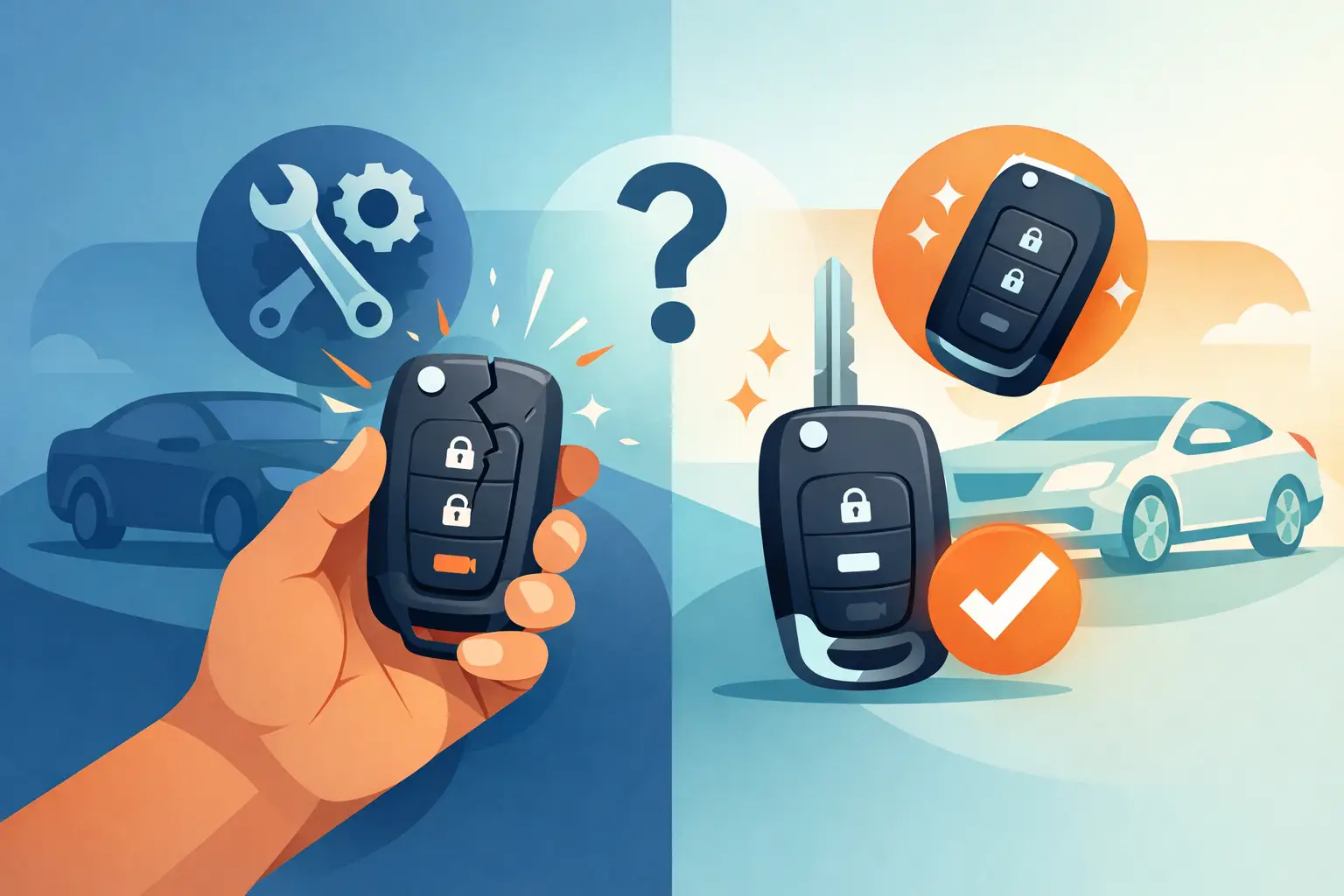
Your remote stops unlocking the car in the supermarket parking lot, or the engine suddenly will not recognize the key before work. The question is usually simple: should you repair or replace key remote parts? The right answer can save time and money, but it depends on what has actually failed. A flat battery is very different from water damage, a cracked casing, or a key that has lost its programming.
Before ordering a cheap replacement online or assuming the whole key is beyond saving, identify the symptoms. A professional auto locksmith can test the remote, vehicle receiver, key transponder, and battery on-site, then provide a practical answer without the delays often associated with a dealership.
When a Key Remote Can Usually Be Repaired
Many remote problems are repairable, particularly when the electronics and transponder chip are still working. The exterior of a car key takes a lot of punishment: drops, tight pockets, work bags, wet hands, and years of pressing the same buttons. Damage to the shell does not automatically mean the remote needs replacing.
A worn or cracked key shell is one of the most common repairs. If the buttons have become loose, fallen through the casing, or only work when pressed in a certain spot, the internal circuit board may be fine. Moving the existing electronics and transponder into a new shell can restore normal use at a lower cost than supplying and programming a full replacement key.
A dead battery is another straightforward fix. If the remote range has gradually reduced, the buttons work only intermittently, or the remote works after several presses, battery power is a likely cause. Replacing the battery may bring it back immediately. However, do not force the case open with a screwdriver if you are unsure how it is designed. It is easy to crack the housing, damage the circuit board, or dislodge a small transponder chip.
Some button faults can also be repaired. The tiny switches beneath the rubber buttons can wear out, become contaminated, or detach from the board after a hard impact. Where the board itself is in good condition, a specialist may be able to repair the button contact rather than replace the entire remote.
A broken emergency key blade is often a separate issue. On many keys, the blade can be cut and fitted while the remote electronics are retained. This is useful when the car still starts and the buttons still work, but the mechanical blade has snapped or worn down.
Signs You Should Replace the Key Remote
Replacement becomes the sensible option when the remote is physically damaged beyond reliable repair, has suffered significant water damage, or no longer communicates with the vehicle after proper testing. A key that occasionally works may feel manageable, but it can leave you stranded without warning.
Water damage is especially unpredictable. A remote dropped into a puddle, washing machine, sink, or drink may work briefly after drying, then fail later as corrosion develops on the circuit board. Removing the battery quickly can limit damage, but heat from a radiator or hair dryer can make matters worse. The remote should be inspected and tested rather than trusted simply because it starts working again.
You may also need replacement if the remote has been run over, badly crushed, or split apart with missing components. A damaged circuit board can sometimes be repaired, but when tracks have lifted, components are missing, or the board is cracked, a replacement remote is generally the more dependable route.
The same applies if the key has been lost or stolen. In that situation, the issue is not just access to the vehicle. A missing key could still be used to unlock or start the car. A locksmith can supply a new key and, where the vehicle allows, remove the old key from the system so it no longer operates the vehicle. For security reasons, that is often better than simply adding another spare.
Repair or Replace Key Remote: What the Symptoms Tell You
The way the fault appears provides useful clues. If the remote buttons do not lock or unlock the doors, but the car starts normally, the problem may be the battery, button switches, remote circuit board, or the vehicle’s central locking system. If the remote unlocks the car but the engine will not start, the fault may involve the immobilizer transponder or key programming rather than the remote buttons.
If neither the buttons nor the engine work, do not assume the key is the only problem. Some vehicle faults affect recognition of every key, including receiver, antenna, fuse, wiring, or ignition-related issues. Testing a spare key can help narrow it down. If the spare works, the original key is the likely cause. If neither works, a proper diagnosis is needed before paying for a replacement.
Keyless proximity fobs add another layer. A weak fob battery can cause “key not detected” messages, reduced range, or a car that will only start when the fob is held close to the start button. Some vehicles need the fob placed in a specific backup location to start when the battery is low. Check the vehicle handbook if available, but do not treat this as a permanent fix.
Why a New Remote Must Be Compatible and Programmed
A replacement remote is not just a piece of plastic with buttons. It must match the vehicle’s make, model, year, frequency, blade style where applicable, and immobilizer system. A remote that looks identical may still be incompatible.
This is why low-cost online remotes can become expensive mistakes. Some are unbranded copies with poor-quality boards or cases. Others are correct for a different market, vehicle year, or frequency. Even a suitable remote will usually need cutting, programming, and testing before it can be relied upon.
Programming pairs the remote to the car for locking functions and programs the transponder so the vehicle recognizes it as authorized to start. On some older models, limited remote syncing can be done through a sequence of ignition and button presses. On many modern vehicles, specialist diagnostic equipment and security access are required. Guessing at procedures or repeatedly trying incorrect programming can waste time and, in some cases, create further issues.
A mobile auto locksmith can identify the correct key type, cut any emergency blade, program the key to the vehicle, and confirm that locking, unlocking, trunk release, remote start where fitted, and engine starting all work before leaving. That is particularly valuable when you have no working key and cannot drive the car to a shop.
Do Not Ignore an Intermittent Key Fault
An intermittent remote is a warning, not a minor inconvenience. If you need to press the button several times, stand close to the vehicle, hold the key at an angle, or repeatedly see an immobilizer warning, arrange help before the key fails completely.
Keeping a working spare is the simplest way to avoid a stressful callout. It also makes diagnosis faster. When a spare key is available, it can be tested against the suspected faulty one and copied before all access is lost. For families, shared vehicles, tradespeople, and anyone who relies on a vehicle daily, a spare can prevent a small key issue from becoming a missed shift or canceled job.
What to Do When Your Remote Fails Away From Home
First, stay calm and avoid forcing the key into the door or ignition. Use the emergency mechanical blade if your vehicle has one and you need access. If the car will not start, try the spare key if available. Check for obvious signs of a flat battery in the remote, but do not keep trying to start the vehicle over and over if an immobilizer warning is displayed.
If you are stranded, a mobile locksmith can come to your location, assess whether repair is possible, and supply a programmed replacement when it is not. Car Key Maker provides on-site help across the West Midlands, Warwickshire, and nearby areas for damaged remotes, lost keys, immobilizer faults, and all-keys-lost situations.
The best time to deal with a failing key remote is before it decides your schedule for you. A quick diagnosis now can mean a simple repair, while waiting may turn the same fault into a lockout or a vehicle that will not start when you need it most.